

Ranking #1 Isn't Enough Anymore: What Pixel Visibility Reveals About the 2026 SERP
 Jojo Furnival
Published August 4, 2026
Search the term "compare desks" in the UK and you'll find Secretlab sitting pretty at position one, with a category page whose title tag is, helpfully, "compare desks". Textbook. Hooray for their SEO team; what total legends.
However, that result is roughly 2,000 pixels down the page. You scroll through two full screens of other stuff before you even lay eyes on it.
Tom Capper brought this uncomfortable idea to our latest webinar: ranking position one doesn't mean what it used to.
Tom is Director of Search Product Strategy at STAT and Moz, he's a regular on the conference circuit, and he's spent years challenging the SEO status quo with data rather than opinion. He also has a great sense of irony, pointing out during the webinar that he, a representative of a rank tracking tool, was telling a room full of SEOs that rank isn't enough as a metric anymore.
I used to work as an agency SEO, so I still get a massive kick out of a number 1 ranking. Who doesn’t? But Tom’s presentation was a real “wake up and smell the coffee” moment; what does rank even mean for us in 2026, and is there something else we should be looking at instead?
Here's the case he made, and what to do about it.
Contents:
Rank no longer means visible
Tom's argument rests on two metrics he thinks the whole industry will adopt before long: pixel position (how far down the page your result sits) and pixel height (how physically large it is).
The data behind it is substantial: Across 46,000 terms, built from 11,500 head terms across 21 topics, tracked on both desktop and smartphone across US and UK suburban locations, in June 2026, he mapped out where results actually land on the page, not just where they rank.
The headline finding is that the median position one result on desktop is about 1,000 pixels down.Position two sits a further 250 to 300 pixels below that. If you take a typical laptop fold at around 800 pixels (a 1080p screen, minus the browser and OS chrome), that means more than half of all number one results on desktop are already below the fold.
To reach what we'd historically have called the bottom of page one, you scroll through roughly five screens. Seeing five traditional organic results above the fold used to be the norm. Now, getting even four or so results above the fold happens less than 1% of the time. Basically never.
There is a best case. About 10% of the time you get one whole organic result above the fold, occasionally with position two sneaking over the line too. But one whole result is a long way from the five we used to see.
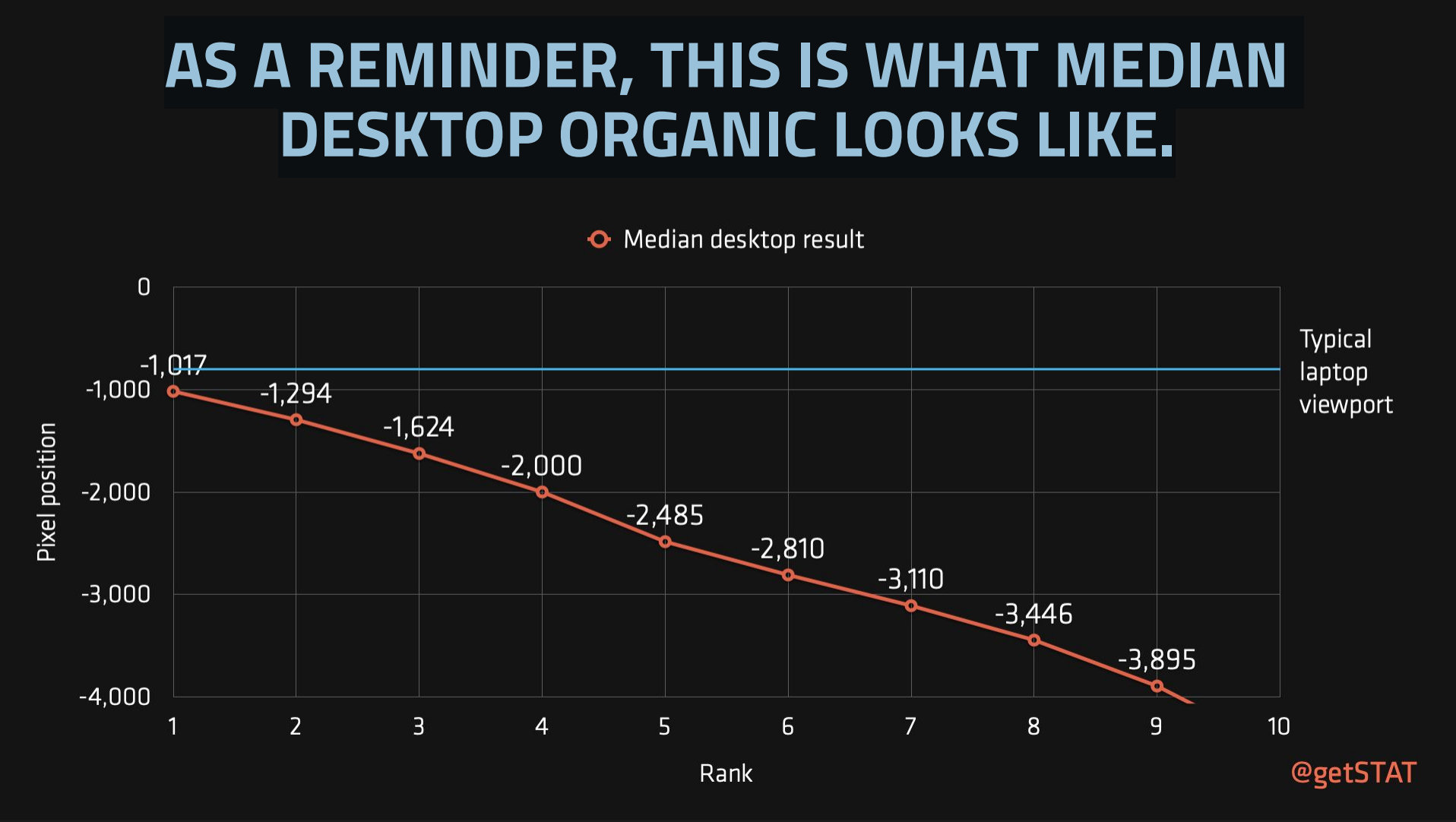
These days, if you're reporting a number one ranking to a client or to leadership, all you're really describing is a SERP location, not a win. The two used to be close to interchangeable. They aren't anymore, so SEOs need to proactively manage those expectations.
The 2026 shift that's being under-reported
Most of us have a reflex explanation for organic sliding down the page: AI Overviews. And for the big step change in 2025, the one the industry took to calling the Great Decoupling, that reflex is right. After Google I/O last year, AI Overviews became far more common and position one stopped reliably earning a click.
But Tom flagged a second, more recent move that he reckons is being under-reported…
After Google I/O this year, results shifted down again, and the driver this time wasn't more AI Overviews or more ads. It was paid results getting physically bigger. Not more numerous, not more frequent. Just taller, taking up more vertical space and pushing everything beneath them further down.
The same pattern shows up on smartphones, though smartphone results start off lower at every rank anyway (and your phone screen is smaller than your laptop to begin with, so the squeeze compounds).
Why does the distinction between AIO vs paid results stealing space matter? Because the diagnosis changes what you'd do. If you assume it's all AI Overviews, you go chasing citations and AI visibility. If the actual mechanism this year is paid result size, that's a different conversation, one that probably starts with the PPC team rather than your content strategy.
Tom also noted that UK ecommerce SERPs still lag behind American ones on this, so if you're only looking at US data you may be seeing a more extreme version than your market shows, and vice versa.
Editor's Note: Discover more SEO changes in 2026 according to these experts.
What's pushing you down depends on your vertical
Organic is being squeezed everywhere, but what's doing the squeezing changes dramatically by vertical, and that changes whether you have a problem you can solve or a situation you have to live with. (Myrian Jessier and I recently chatted about the difference between a problem and a situation and now I’m obsessed with the idea.)
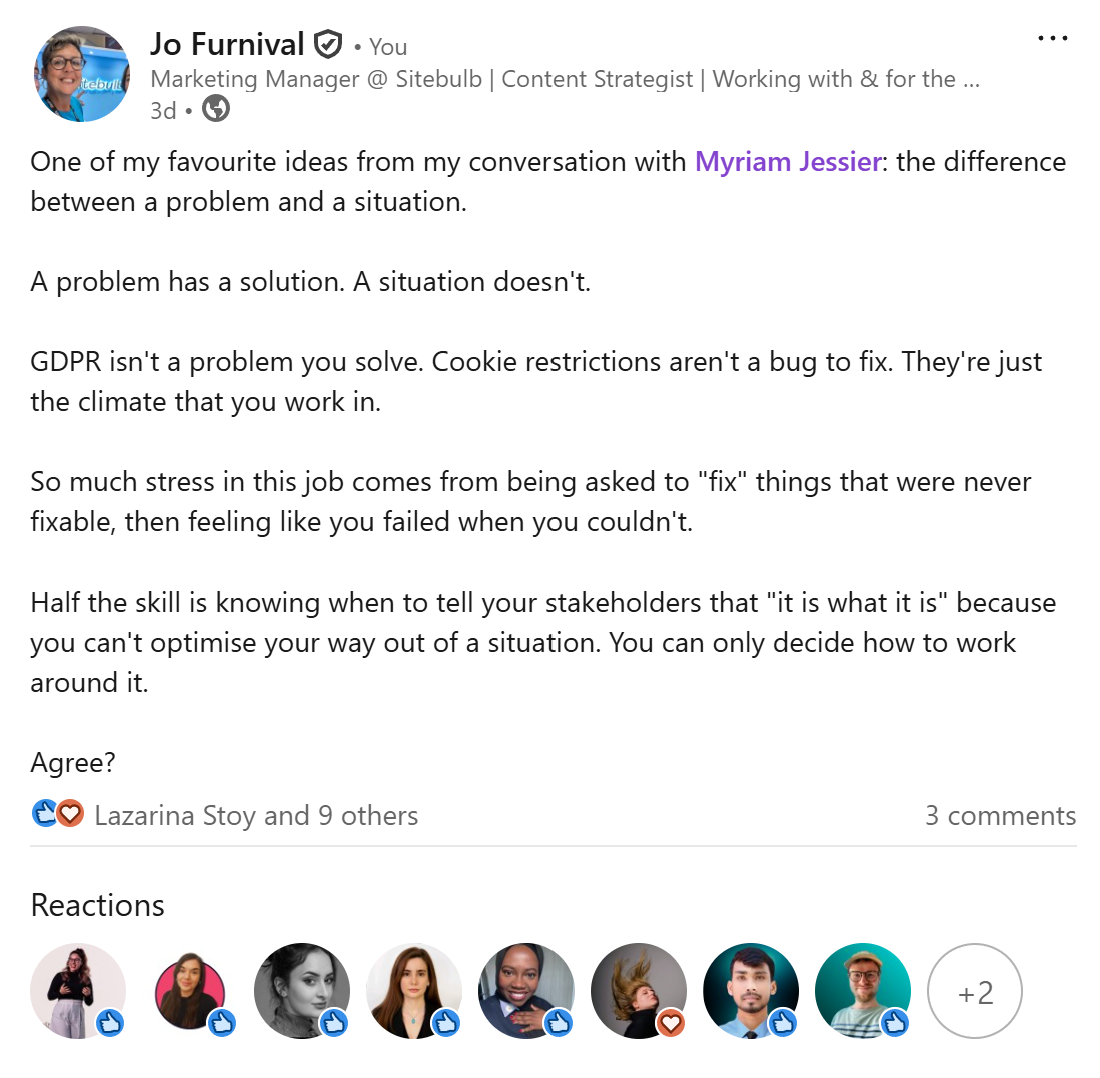
In Tom's data:
Home and garden: Popular products push organic down. On smartphone, the median number 1 can be about three screens deep of scrolling.
Arts and entertainment: It's all about the Knowledge Graph.
Dining and nightlife: Local Packs.
The reason this matters is that some of those features are winnable and some really aren't. If you're in dining and nightlife and Local Packs are the thing sitting above your organic result, that's not a disaster, because Local Packs are something you can influence. If you're in arts and entertainment and it's the Knowledge Graph eating your space, that's a harder conversation, because for most brands, a Knowledge Graph doesn't represent much of an opportunity.
So instead of "how do I rank higher?" ask, "what specifically is sitting above my organic result, and can I do anything about it?"
And of course, the answer DEPENDS 🍻 based on who you are and what you sell. So Tom's advice is to run this analysis on your own keywords rather than trusting a generic industry average.
Optimise for size, not just position
If rank is a weak proxy for being seen, the logical response is to optimise for what actually draws the eye. And that means thinking about how big and how visual your result is, not just where it sits.
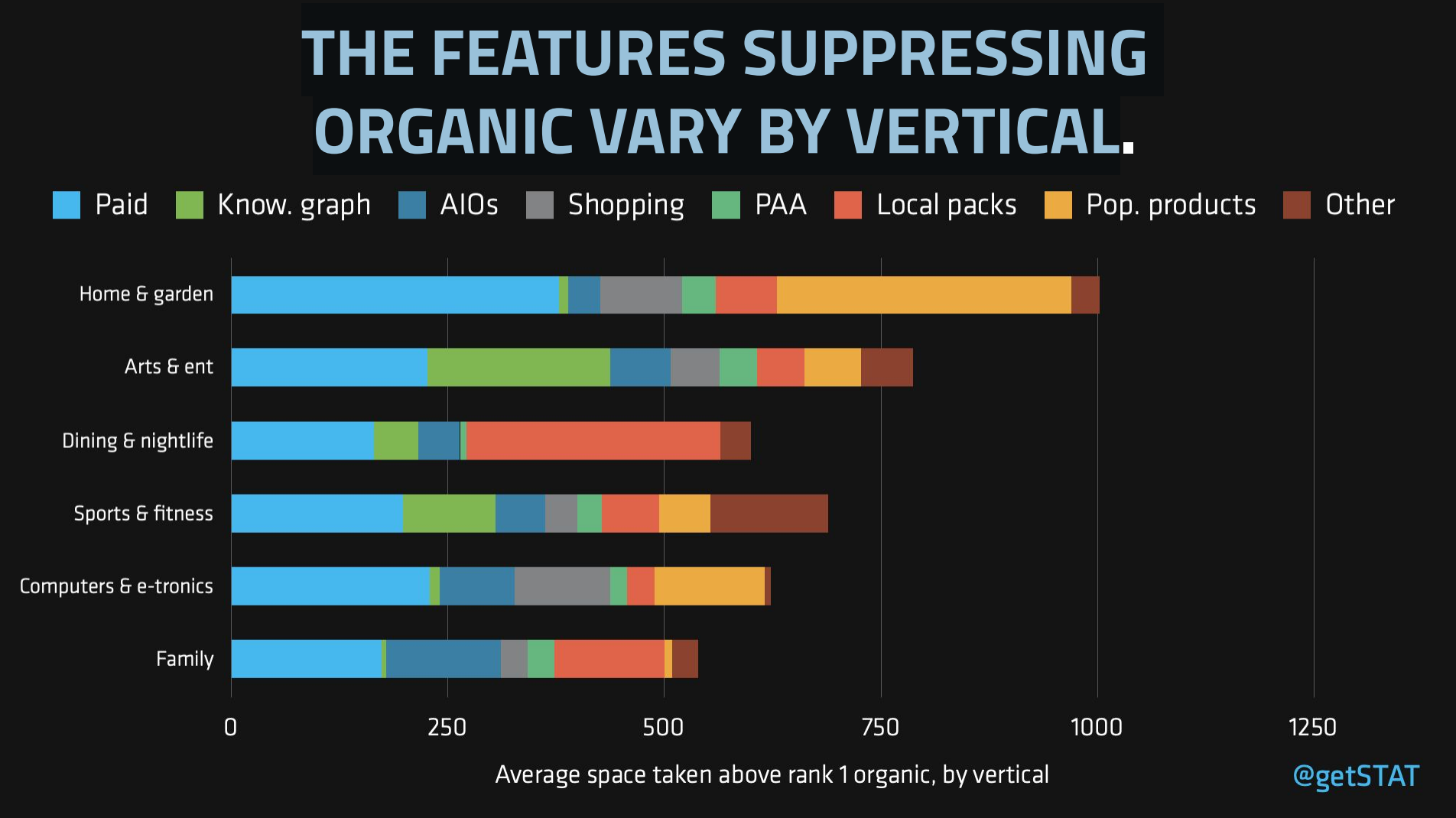
Tom used two experience-day brands to make the point:
On the same SERP, a Virgin Experience result with rich, visual formatting is far more striking than a plainer Red Letter Days one, regardless of which you hit first. Then he pushed it further with a cruise example: imagine you're Royal Caribbean, and you can either gain a position one ranking that's a plain template link, or a position two result that's large and visual. You'd take position two every time.
The practical levers here are a familiar story:
Structured data, so you're eligible for the richer result types in the first place.
Your own imagery and video, which can make an organic result noticeably larger. Tom's data suggested a video attached to a result can make it more than a third bigger.
Sitelinks, where you have other relevant pages to earn them.
There's one spot where Sitebulb can genuinely help, so I'll say it once and move on: winning most of these rich result types depends on valid, correctly implemented structured data, which is exactly the kind of thing Sitebulb can flag before it costs you the eligibility.
Where this leaves SEO: A visibility and brand channel
Fewer clicks available at the top of the funnel means SEO starts to look less like a pure performance channel and more like brand marketing. Yes, BRAND MARKETING. One of my fav topics.
Tom's framing was a billboard: you don't expect a phone call the moment someone drives past it, but you'd still rather it was big than small, and you measure it in impressions and presence rather than attributable clicks.
There's data underneath this too. Tom reran a study he first published in 2017 on which signals predict rankings for the most contested terms, and found that brand has become a genuinely strong predictor. Google itself has effectively said, via NavBoost, that a recognised brand people are used to seeing gets a lift in the re-ranking.
The same logic applies to GEO, and it's why Tom warned against treating AI as a traffic channel. ChatGPT referral traffic is still a low single-digit share of site traffic, even after the widely shared story that it halved and then doubled (something that halves and doubles was very small to start with, and still is). His example was a Google AI Mode query where every single vehicle mentioned was an Audi, but Audi wasn't cited anywhere. No click. And yet, for a brand, that's about the best result you could hope for.
So presence becomes the metric, maybe sentiment too, rather than citations or referral clicks. The hard part, as Tom put it, isn't getting the SEO team on board but the C-suite conversation, where you have to walk back fifteen years of telling leadership that clicks are the only thing that counts. Doh!
That's also where a term Myriam Jessier has been kicking around comes in: “technical branding”. SEOs already tend to inherit the cross-functional, outside-the-box technical work in most organisations (Tom reckons around 80% of SEO teams end up owning the Google Analytics install, which has nothing to do with SEO).
That leaves us unusually well placed to own brand-building from a technical and AI-visibility angle, if we want it.
TL;DR key takeaways
💡 The median number one desktop result now sits around 1,000 pixels down, and more than half of #1 results are below the fold. Rank alone no longer tells you whether you're seen.
💡 The 2026 downward shift was driven by paid results getting physically bigger, not by more AI Overviews or more ads. Diagnose the cause before you pick a fix.
💡 What pushes your organic result down is vertical-specific. Identify the feature above you (Local Pack, Knowledge Graph, popular products) before deciding whether it's winnable.
💡 A position two result with strong visual weight can beat a plain position one. Prioritise structured data, imagery, video and sitelinks to win on size, not just position.
💡 Treat SEO increasingly as a visibility and brand channel. Measure presence and impressions, not just clicks, and apply the same logic to GEO.
Watch the full webinar with Tom Capper for the complete data walkthrough, plus slides, and the audience Q&A: Are Your Rankings Visible? SERP Data, Dominance & Opportunities in 2026

Sitebulb is a proud partner of Women in Tech SEO! This author is part of the WTS community. Discover all our Women in Tech SEO articles.

Jojo is Marketing Manager at Sitebulb. She has 15 years' experience in content and SEO, with 10 of those agency-side. Jojo works closely with the SEO community, collaborating on webinars, articles, and training content that helps to upskill SEOs.
When Jojo isn’t wrestling with content, you can find her trudging through fields with her King Charles Cavalier.


Related Articles
 How to Audit the Entity Signals That Shape Brand Understanding in AI Search

 How Siri AI Could Change Search, and What Technical SEOs Should Do Now

 I Asked ChatGPT for the UK's SEO, Content and AI People. It Listed Me First.

 Sitebulb Desktop
Find, fix and communicate technical issues with easy visuals, in-depth insights, & prioritized recommendations across 300+ SEO issues.
- Ideal for SEO professionals, consultants & marketing agencies.
 Sitebulb Cloud
Get all the capability of Sitebulb Desktop, accessible via your web browser. Crawl at scale without project, crawl credit, or machine limits.
- Perfect for collaboration, remote teams & extreme scale.