

How Siri AI Could Change Search, and What Technical SEOs Should Do Now
 Christopher Lara
Published July 20, 2026
This week, we're grateful to Christopher Lara who shares hands-on testing of Apple's new Siri AI and what it reveals about the shift from ranking for clicks to being eligible for AI-generated answers.
At Apple’s Worldwide Developers Conference (WWDC) in June 2026, Apple introduced Siri AI, the rebuilt Apple Intelligence version of its assistant. It is in beta now and ships broadly this fall across iOS 27, macOS 27, iPadOS 27, and visionOS 27. The easy headline is that this kills SEO. It doesn't.
I spent time running real searches through Siri AI, and what I saw was more interesting and more useful than the hype suggests: the answers are built from ordinary web pages, the same technical foundations still decide who gets used, and the goal shifts from ranking for a click to being eligible for an answer.
This piece covers what Siri AI actually is, what it did on eight real queries I tested, and the audit and measurement changes that follow. I work in ecommerce SEO, so I used office-product searches, but the patterns generalize to any commercial space.
Contents:
- The search box is moving into the operating system
- Two terms, one shift
- What I saw: eight real queries
- What kinds of searches shift first
- Why this isn't the end of traditional SEO
- From ranking for clicks to being eligible for answers
- The technical SEO foundations of AEO and GEO
- How to measure impact when clicks are harder to attribute
- The takeaway
- TL;DR key takeaways
The search box is moving into the operating system
First, what Siri AI actually is:
Siri AI is powered by Google's Gemini models under a licensing deal, but it is not a rebadged Gemini Assistant. Apple's third-generation Foundation Models are five models built with Google: four are customized Gemini variants retrained by Apple to run on Apple Silicon, and the fifth and most capable runs on Google servers.
One detail matters most for us: Siri AI uses its own web index and knowledge, not Google's web search or Knowledge Graph.
It is also gated by hardware:
- Core Siri AI search behavior needs an Apple Intelligence-capable device - an iPhone 15 Pro or the iPhone 16 line and newer, an Apple Silicon Mac, or a recent iPad.
- Two extras, custom voices and more accurate dictation, need the most powerful on-device model and 12GB of memory. Among iPhones, only the iPhone Air and the 17 Pro and Pro Max clear that bar, though M3-and-newer Macs and M5-and-newer iPads with enough memory get it too.
- Siri AI will not be available in the EU at launch.
Those two hardware-gated extras are narrow; the core Siri AI search behavior runs across the wider supported lineup.
The reason this matters for search behavior is distribution. Most people never downloaded a separate AI app. Now a capable answer engine sits behind the button they already press and the field they already type into, with nothing to install and nothing to subscribe to. When the friction of asking an assistant drops to near zero, more of the questions that used to start a Google session start an assistant session instead.
Two terms, one shift
AEO, answer engine optimization, is preparing content so an answer engine can extract and present it.
GEO, generative engine optimization, is the broader practice of making sure your brand and content are represented well inside AI-generated responses. Both describe the same change in different words: optimizing to be used by a system that answers, rather than a results page that lists.
What I saw: eight real queries
Apple's revamped Siri took roughly two years to get from its first demo to release, so I wanted to see what actually shipped rather than what the keynote promised. I ran eight searches through Siri AI in beta and saved the output. Here is what happened, and why each pattern should change how you work.
The same question can land on completely different surfaces. "What's the best office chair for tall people," "best electric stand-up desk," and "what size office chair for someone 6'5"" each returned a written, synthesized answer with a Sources panel.
But "Staples office chairs" and "where can I buy office supplies near me" returned no AI answer at all. They returned an Apple Maps card for the nearest physical store, with Call and Directions buttons and a Yelp rating, and no web sources. Siri read those as local and navigational intent and routed them to Maps. So for a chunk of commercial queries, the thing to win is not the answer box. It is the map pin, which is governed by your business listing and local data.
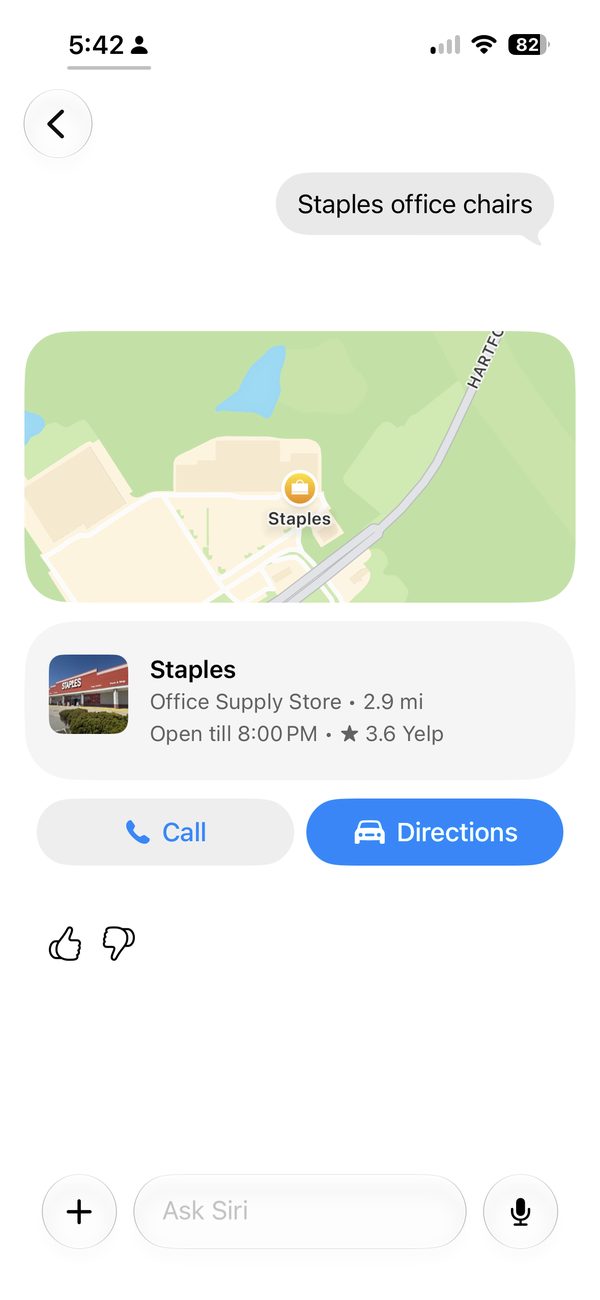
"Staples office chairs" returned no AI answer at all, just an Apple Maps card for the nearest store.
What Siri recommends and what Siri cites are two different lists. On the tall-chair query, it recommended premium models: the Herman Miller Aeron Size C, the Steelcase Leap V2, a Secretlab gaming chair, and an Oak Hollow tall model.
The Sources panel cited a dozen third-party review and roundup sites such as testbeforeyoubuy.com, postureranked.com, tallchairadvisor.com, and Forbes. It did not cite Herman Miller or Steelcase product pages.
The brands it named were not the sources it used. That is the single most important takeaway here. Being recommended by an assistant and being cited as a source are separate outcomes, and you influence them in different ways.
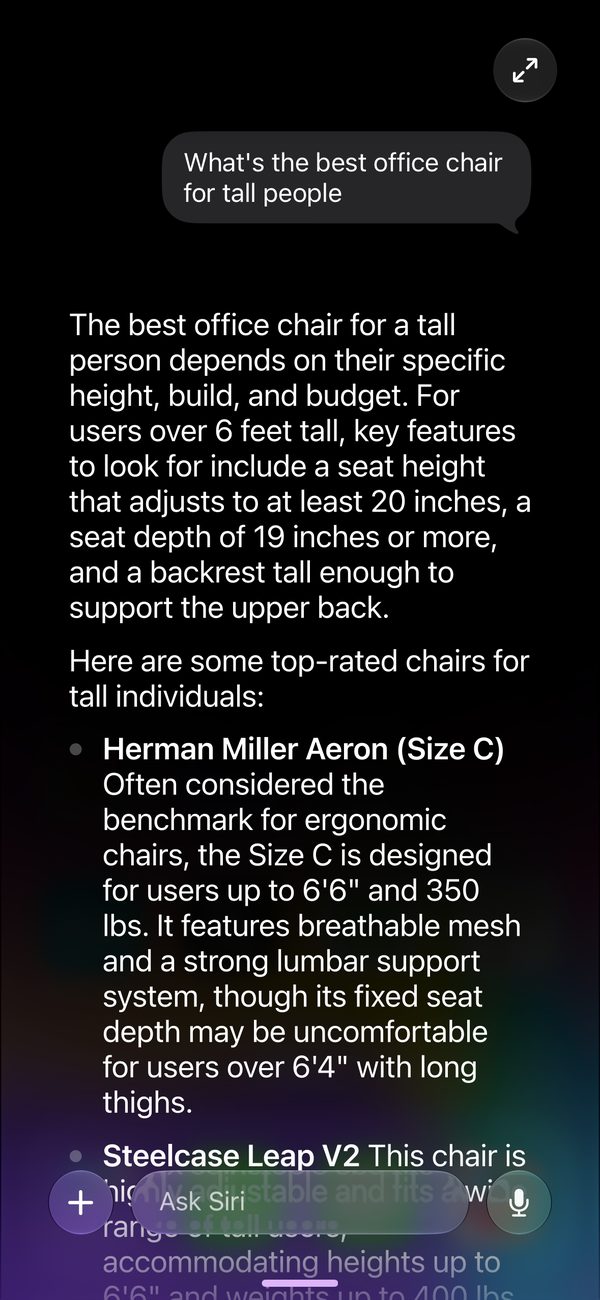
What Siri recommends: premium brands like the Herman Miller Aeron and Steelcase Leap.

What Siri cites for the same query: third-party review and roundup sites, not the brand pages.
There is a clear exception: When I searched "standing desks at Staples," naming a retailer and a product together, the Sources panel did cite retailer-owned pages, including Staples Advantage and Quill, next to a couple of independent roundups. So vendor pages earn citations on specific, branded, product-level queries even when they are absent from generic ones.
This lines up with a separate test I ran across other AI engines, 216 logged answers in all, where the gap between recommended and cited narrowed as queries got more specific.
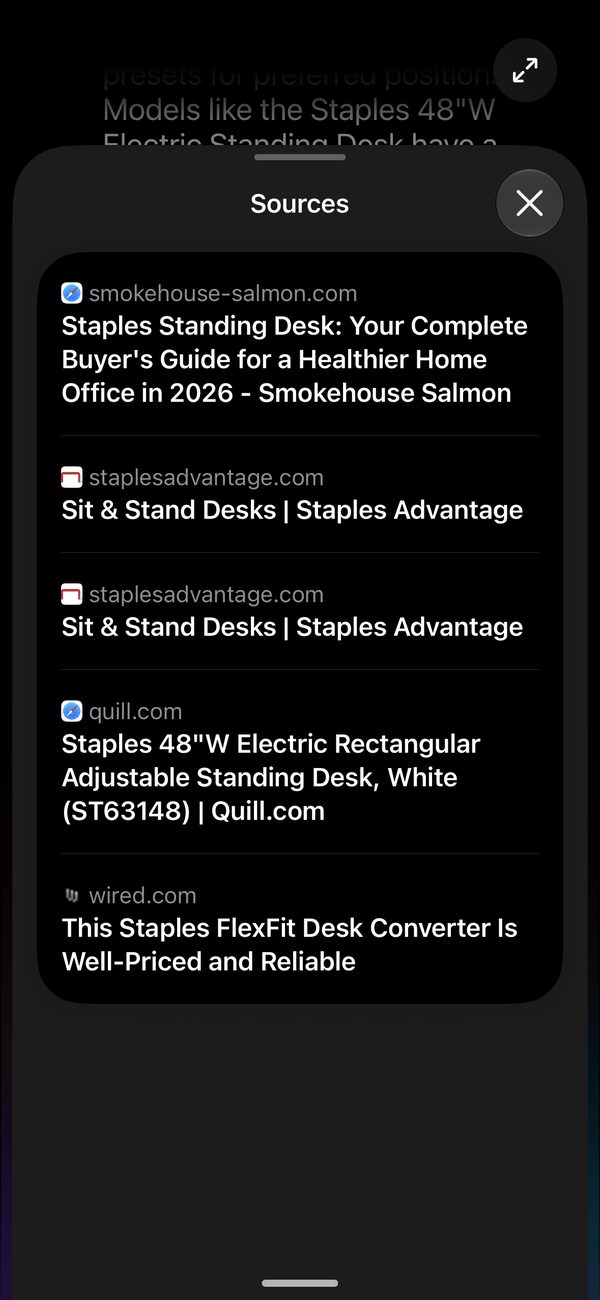
Name the retailer and the product together and the vendor's own pages get cited: here, Staples Advantage and Quill.
Refining the question in plain language flips the entire result. After the first chair answer, I replied, "I'm 6'5" with a $400 budget." Siri swapped the whole recommendation set, dropping the premium chairs and surfacing a FlexiSpot model, the IKEA Markus Large, and an Autonomous chair.
The cited sources changed too. One conversational turn rewrote both the products and the publishers behind them. Traditional search has no equivalent to that, and it means the query you optimize for can move inside a single session.
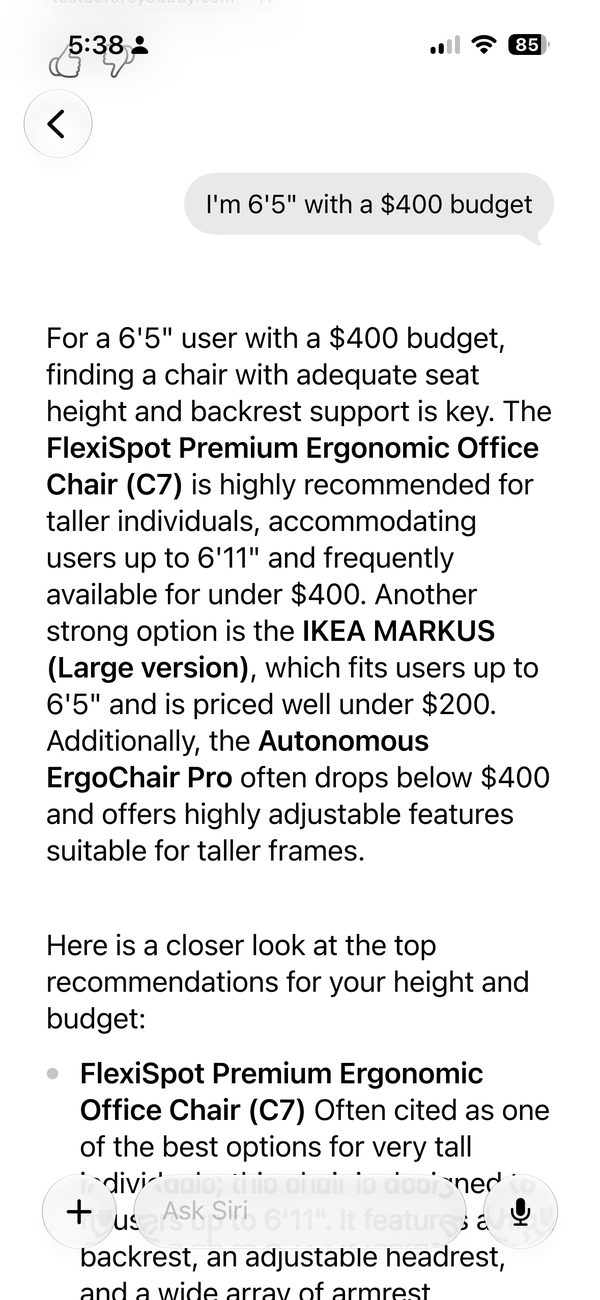
After "I'm 6'5" with a $400 budget," the entire recommendation set and its sources changed.
The sources it pulls match the type of question. The how-to query, "how do I adjust seat depth on an office chair," cited only instructional guides. The sizing query cited tall-user buying guides. Siri draws from a corpus that fits the task, which rewards content built to answer one specific job over a broad category page trying to cover everything.
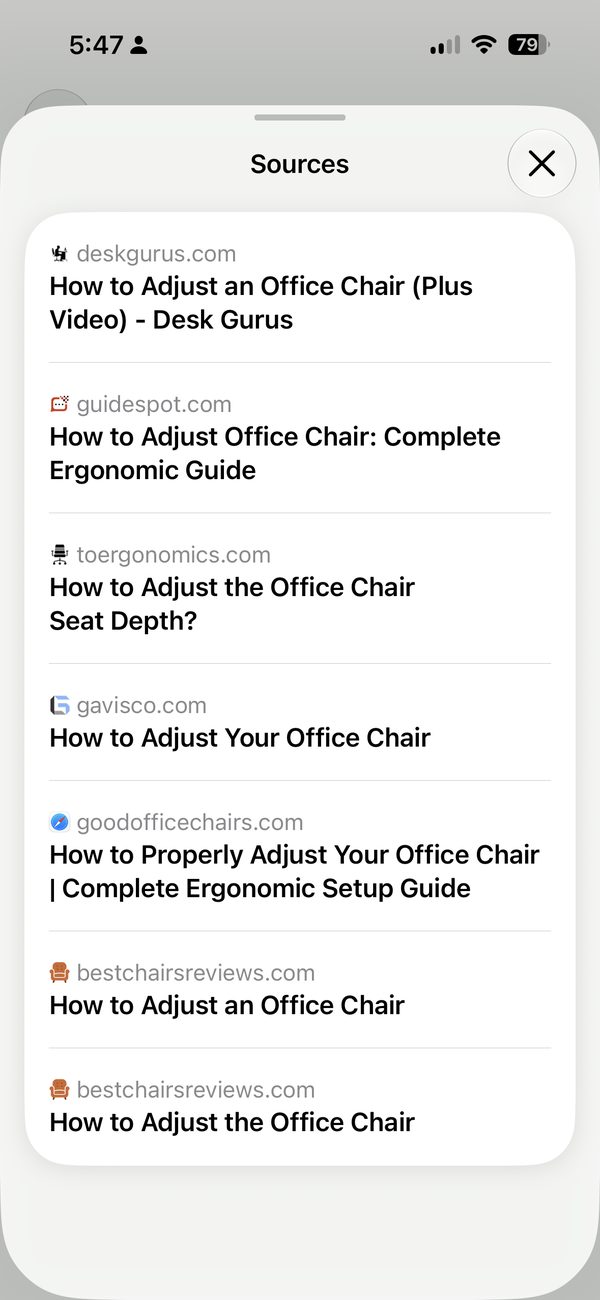
A how-to query pulled only instructional guides. The cited corpus matches the job the searcher is doing.
It builds the format on the fly. For the desk query it generated a comparison table with model, key feature, and weight capacity. For the sizing query it produced a labeled dimensions breakdown. For chairs it wrote pros and cons. Your content has to be granular and cleanly structured enough to be pulled apart and rebuilt into whatever shape the assistant chooses.
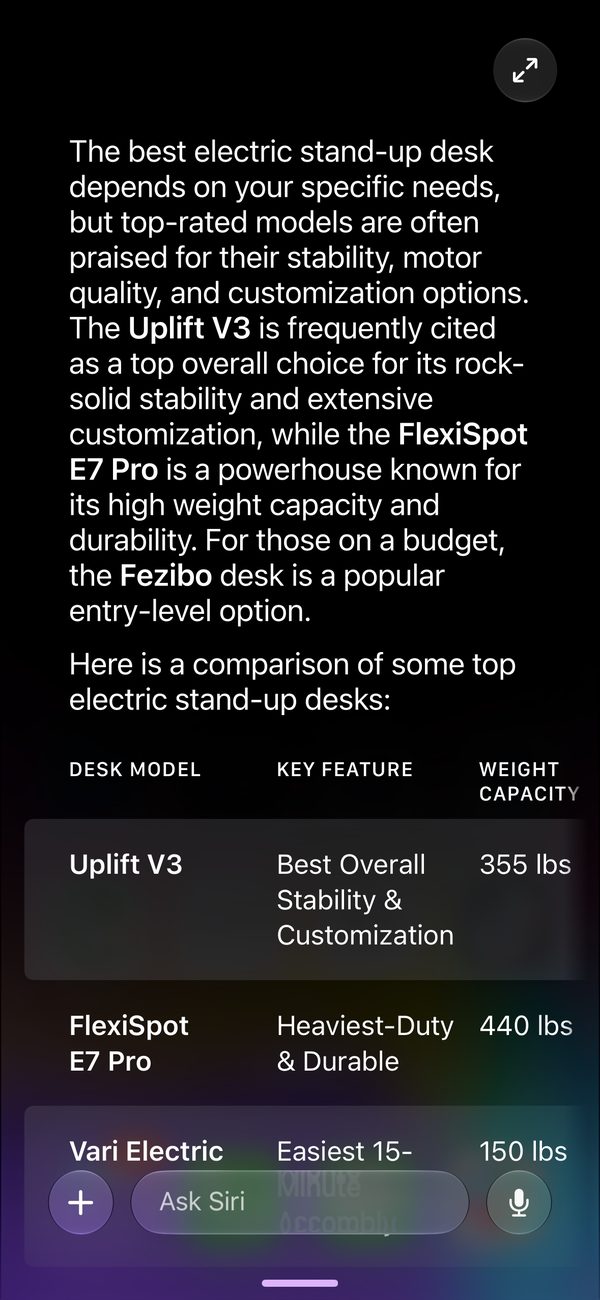
Siri built this comparison table on the fly from page content, which rewards clean, structured, liftable facts.
Two smaller notes. Every answer ended with a disclaimer along the lines of "I'm an AI and may make mistakes, so verify important details," and several asked a clarifying follow-up question. And across the generic research queries, no large retailer product pages appeared as sources unless the retailer was named. That absence is the opening.
What kinds of searches shift first
The queries most exposed to this change are informational and research-stage commercial questions: "best X for Y," "how do I," "what size," comparisons, and buying criteria. Those return synthesized answers, and that is where the zero-click pattern bites hardest.
Two categories behave differently. Local and navigational queries route to Maps, so they become a local-SEO and business-listing problem. Specific, branded, product-level queries still surface vendor pages as sources, so they stay closer to classic SEO. Knowing which bucket a query falls into tells you where to spend.
Why this isn't the end of traditional SEO
Every Siri AI answer I saw was assembled from regular, crawlable web pages. The assistant did not invent its recommendations. It read sources, synthesized them, and cited a subset. If your pages cannot be crawled, rendered, parsed, and trusted, you are not in the candidate set the model draws from. Traditional technical SEO is the entry fee for being eligible.
What changes is the objective. You are no longer only trying to rank a URL so a person clicks it. You are trying to make your content the thing an answer engine reaches for, and to make sure your brand shows up accurately when it does. The discipline is the same. The finish line moved.
From ranking for clicks to being eligible for answers
Think of it as eligibility rather than position. To be eligible, content has to clear a few gates:
- Reachable - crawlable and indexable.
- Machine-readable - renders without depending on scripts a fetcher won't run, and carries clean structured data.
- Extractable - organized so a single fact, step, or comparison can be lifted out cleanly.
- Trusted - clear authorship, evidence, and topical authority, since the assistant is openly hedging on accuracy and leans on sources that look credible.
The recommended-versus-cited gap maps onto two distinct goals. To be recommended, your brand and products need to be well represented across the independent reviews and roundups the assistant trusts, because those are what it cites for generic queries.
To be cited directly, your own pages need to be specific and authoritative enough to win on branded, product-level questions. Most ecommerce teams over-invest in their own product pages and under-invest in showing up credibly in third-party coverage. What I saw suggests both matter, for different query types.
The technical SEO foundations of AEO and GEO
This is where a crawl earns its keep. Each item below ties to whether an assistant can find, read, trust, or quote your page, rather than to general best practice.
Crawlability and indexability
Everything starts with reach. If an answer engine's fetcher can't reach a page, or the page is excluded from indexing, it cannot be a source. Audit blocked paths, accidental noindex tags, orphan pages, and crawl traps first.
Rendering
A page can be perfectly reachable and still be invisible. If your key content only appears after client-side JavaScript runs, a fetcher that doesn't execute that script sees an empty shell. Confirm that product specs, answers, and body copy exist in the rendered HTML a crawler actually receives.
Structured data
Clean schema is what makes your facts liftable. Siri generated tables and dimension breakdowns straight from page content. Product, FAQ, HowTo, and review schema hand it clean, labeled facts to pull instead of forcing it to guess from prose. This is the most direct lever for being quoted accurately.
Internal linking and entity clarity
A model also has to work out what a page is about and how far to trust it. Consistent naming of products and entities, plus a sensible link structure, help a model understand and trust the page. Ambiguity gets you left out.
Canonicals
Canonicals keep your authority from splitting across duplicates. If three URLs hold the same content, consolidate so the signal concentrates on one citable page.
Page speed and accessibility
Speed and accessibility earn a place here for an indirect reason: both track with clean, well-ordered markup, and clean markup is easy to parse. Accessible heading structure and semantic HTML help machines and people read a page the same way.
Content freshness
Recency carries real weight, because these answers skew current. Several of the sources I saw carried the current year in their titles, and stale buying guides lose to recently updated ones.
Author and source trust signals
When the assistant itself tells users to double-check the answer, trust signals stop being optional. Real authorship, citations, and demonstrated expertise are what separate a citable source from filler.
Product, local, and FAQ content
Match the content to the query types you care about. Product and FAQ content feed the research answers; local content and your business listings feed the Maps results that branded and "near me" queries return. Cover all three on purpose.
Task-specific content
Finally, a page built to answer one job beats a broad category page. The assistant cited focused guides. A focused guide that fully answers "what size chair for a 6'5" person" will out-cite a generic chair category page every time.
How to measure impact when clicks are harder to attribute
When the answer happens on the assistant and no click follows, your dashboards will undercount your influence. You need proxies.
Search Console
Watch for impressions and average position holding or rising while clicks soften on informational queries. That divergence is the zero-click signature, and it is evidence you are being surfaced even when the traffic doesn't follow.
Bing Webmaster Tools
Its AI Performance report shows when your pages are cited in AI answers across Copilot and Bing's AI summaries, with views for citation share and the queries that trigger them. Search Console's generative-AI reporting is newer and thinner by comparison, currently impressions only. Siri uses its own index, so neither tool reports it directly, but Bing's data is the closest read most teams have today on how an AI engine treats their content, and the patterns tend to rhyme across engines.
Branded search lift
If assistant answers expose your brand without a click, you often see it later as growth in branded queries and direct visits. Set a baseline now so you can see the change.
Referral traffic from AI sources
Some assistant answers do drive taps to a cited source. Segment that traffic where you can identify it, and treat citation taps as a real channel.
Share of voice in answers
Run a fixed set of your priority queries through the assistant on a schedule, and log whether you are recommended, cited, both, or absent. That is the cleanest read on whether your AEO work is moving anything, and it is the only metric that captures the recommended-versus-cited split.
Local and branded queries
Since those route to Maps, track listing impressions, calls, and direction requests as the conversion surface, not your product page.
None of these is as tidy as a click. Together they tell you whether you are eligible, surfaced, and chosen.
The takeaway
Siri AI deserves attention not because it is magic, but because it makes AI search ordinary. The answers are still built from web pages, still depend on crawlability and structured data and trust, and still reward the site that is easiest to read and hardest to doubt.
The work in front of technical SEOs is to make their content eligible for answers, to earn a place in the third-party sources assistants cite, and to win the specific branded queries where their own pages still get pulled in. Run your own priority queries through it this week. The gap between what it recommends and what it cites is your roadmap.
TL;DR key takeaways
💡 Siri AI still needs the web: every answer comes from crawlable, ranked pages, so basic technical SEO remains the entry fee for showing up at all.
💡 Being recommended and being cited are different games. Siri often names premium brands but cites independent review sites instead of the brand's own pages - work on both, separately.
💡 Naming a specific retailer or product changes this: branded, product-level queries do pull vendor pages in as sources, unlike generic research queries.
💡 Query type decides the surface. Local and navigational searches route to Apple Maps instead of an AI answer, which makes business listings the thing to optimize there.
💡 Structured data, clean rendering, and single-purpose content are what let Siri lift facts cleanly - a broad category page won't out-cite a focused guide.
💡 Clicks won't tell the whole story anymore. Track Search Console impressions, Bing's AI Performance report, branded search lift, and your own logged answers to see whether you're actually being surfaced.
A note on method: the Siri AI behavior described here comes from my own testing in the iOS 27 beta in June 2026, using office-product queries from a US, Massachusetts location. Assistant answers vary by user, device, location, and individual run, so your results will differ. Product names and cited domains are examples of what I saw, not a fixed or ranked list. The 216-answer cross-engine comparison referenced above is my own informal test, not a published study. Apple's device support, rollout timing, and regional availability are current as of late June 2026 and may change.

Christopher Lara is the SEO Product Manager at Staples, where he owns organic search as a product across Staples.com and the company's B2B platform. His day-to-day covers content strategy, technical SEO, performance analysis, and cross-functional work with engineering, merchandising, and editorial teams. Outside of Staples, he runs hands-on experiments in AI search, testing how assistants like Siri, Perplexity, and Claude cite and recommend brands.

Related Articles
 How to Audit the Entity Signals That Shape Brand Understanding in AI Search


 Ranking #1 Isn't Enough Anymore: What Pixel Visibility Reveals About the 2026 SERP

 I Asked ChatGPT for the UK's SEO, Content and AI People. It Listed Me First.

 Sitebulb Desktop
Find, fix and communicate technical issues with easy visuals, in-depth insights, & prioritized recommendations across 300+ SEO issues.
- Ideal for SEO professionals, consultants & marketing agencies.
 Sitebulb Cloud
Get all the capability of Sitebulb Desktop, accessible via your web browser. Crawl at scale without project, crawl credit, or machine limits.
- Perfect for collaboration, remote teams & extreme scale.