

How to Audit the Entity Signals That Shape Brand Understanding in AI Search
 Chioma Anunobi
Published August 20, 2026
This week, Chioma Anunobi tackles a question AI search has made urgent: does your schema actually help machines understand your brand, or just pass validation? Using a Sitebulb audit of the Search Africon site, they lay out a repeatable framework for auditing the entity signals that shape how AI systems read a brand.
Schema isn't broken, but your entity signals might be.
For years, structured data has been treated as the foundation of technical SEO. We validate our markup, chase green checkmarks in testing tools, and celebrate when Google can parse an entity type without throwing an error.
But AI search has changed the standard. Today's search engines and AI systems are trying to answer a much bigger question: "Can I confidently understand this brand, its relationships, and how everything across this website fits together?"
That's where many technically sound websites begin to fall short.
This article walks through the process of entity alignment using a real Sitebulb audit.
Contents:
Why entity alignment?

Most schemas are syntactically correct but entity-blind. They tell machines what something is, but not necessarily who it is, how it connects to other entities, or whether every signal across the website tells the same story.
Schema is only one signal in a much larger system. Think of it as storytelling for machines. The problem is that different parts of the website tell slightly different versions of it.
That's where entity alignment becomes important.
Entity alignment ensures that every technical and content signal across a website consistently reinforces the same understanding of the same entities. Schema is one part of the equation, confidence comes from every layer of your website sending the same clear signals.
In this article, I share a case study of using a Sitebulb audit of Search Africon, an African SEO and digital marketing conference, to investigate what the crawler surfaced, and validate those findings against the live implementation. Then, we'll separate implementation issues from CMS limitations and identify the entity signals that matter most for how AI systems understand a brand.
By the end, you'll have a repeatable framework for auditing entity alignment. You'll also know how to prioritise fixes, and distinguish between structured data that simply validates and structured data that contributes to brand understanding in AI search.
What machines are trying to build
When most SEOs think about structured data, they focus on implementation: Choosing the right schema type, and markup that validate to qualify for Google's rich results.
Those concerns still matter, but they are only part of the picture. Machines are trying to understand entities.
Every time a search engine or AI-powered system processes a website, it attempts to build a graph of distinguishable things and the relationships between them. Google describes this process as moving from keyword matching toward understanding entities and their attributes.
A company, founder, conference, speaker, sponsor, and venue are all entities. Each becomes a node in a much larger graph that machines continuously refine using evidence collected from across the web.
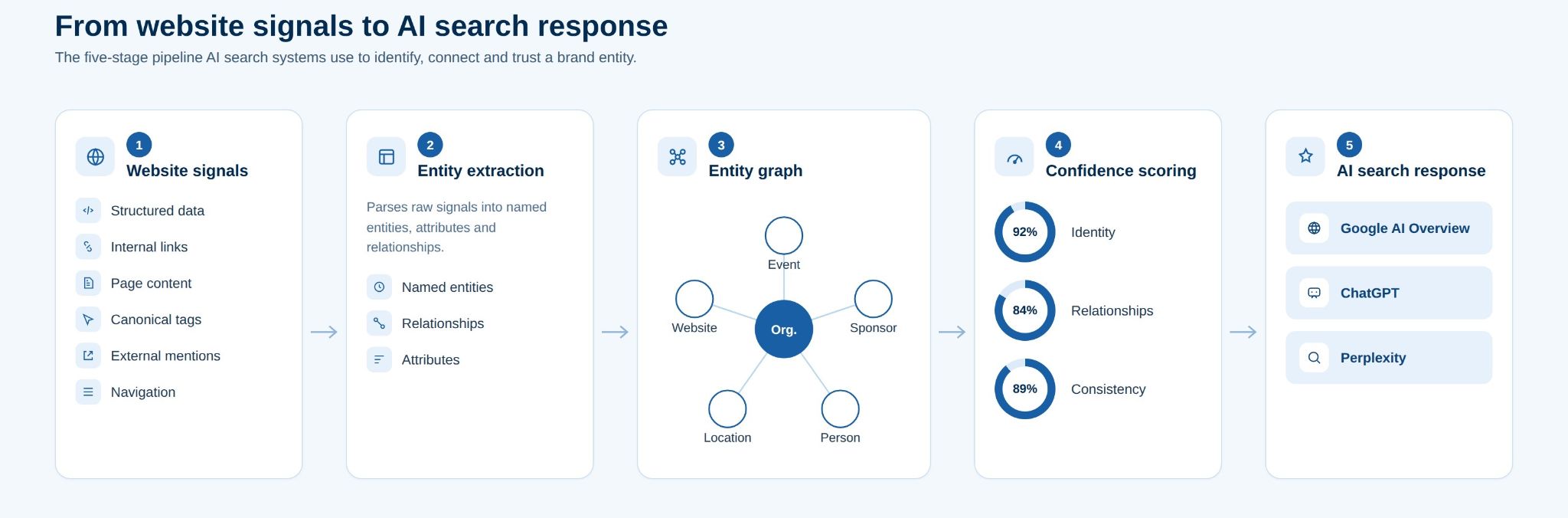
Structured data provides one of the clearest ways to identify those nodes and describe how they are related. But structured data should never be evaluated in isolation.
Search engines compare those declarations against everything else they can observe. They:
- examine whether the page content supports the schema
- follow internal links to see how entities connect across the site
- compare canonical URLs, navigation patterns, recurring terminology, and references from external websites.
Every one of those signals either strengthens or weakens confidence in what the structured data is claiming. The rest of the website provides the evidence.
This distinction matters in an AI-first search landscape. Because, a valid schema graph sitting on top of fragmented content and disconnected relationships still leaves machines with unanswered questions.
Why entity signals break and what schema reveals when they do
Structured data rarely comes first.
Most websites begin with content, navigation, templates, URLs, and internal linking. Schema is often layered on much later, sometimes through an SEO plugin, other times through a CMS extension, and after months of publishing content.
By the time structured data is added, it is describing a website whose architecture has already been established. It documents the entity relationships your website already communicates. And if those relationships are inconsistent or incomplete, schema does not hide that; it reflects it.
Here are the three places I found that reflection to be most revealing.
1. Naming drift creates competing entity signals
The easiest entity problem to overlook is also one of the most common. Someone abbreviates the company name in navigation. A social profile uses a different capitalisation, or a conference is referred to slightly differently in blog posts than on registration pages.
To people, these differences are insignificant, but to machines building an entity graph, they're separate pieces of evidence that must be reconciled.
During the Search Africon audit, one of the first things I investigated was how consistently the brand was represented across the website and the wider web.
Different name variations appeared across digital properties.
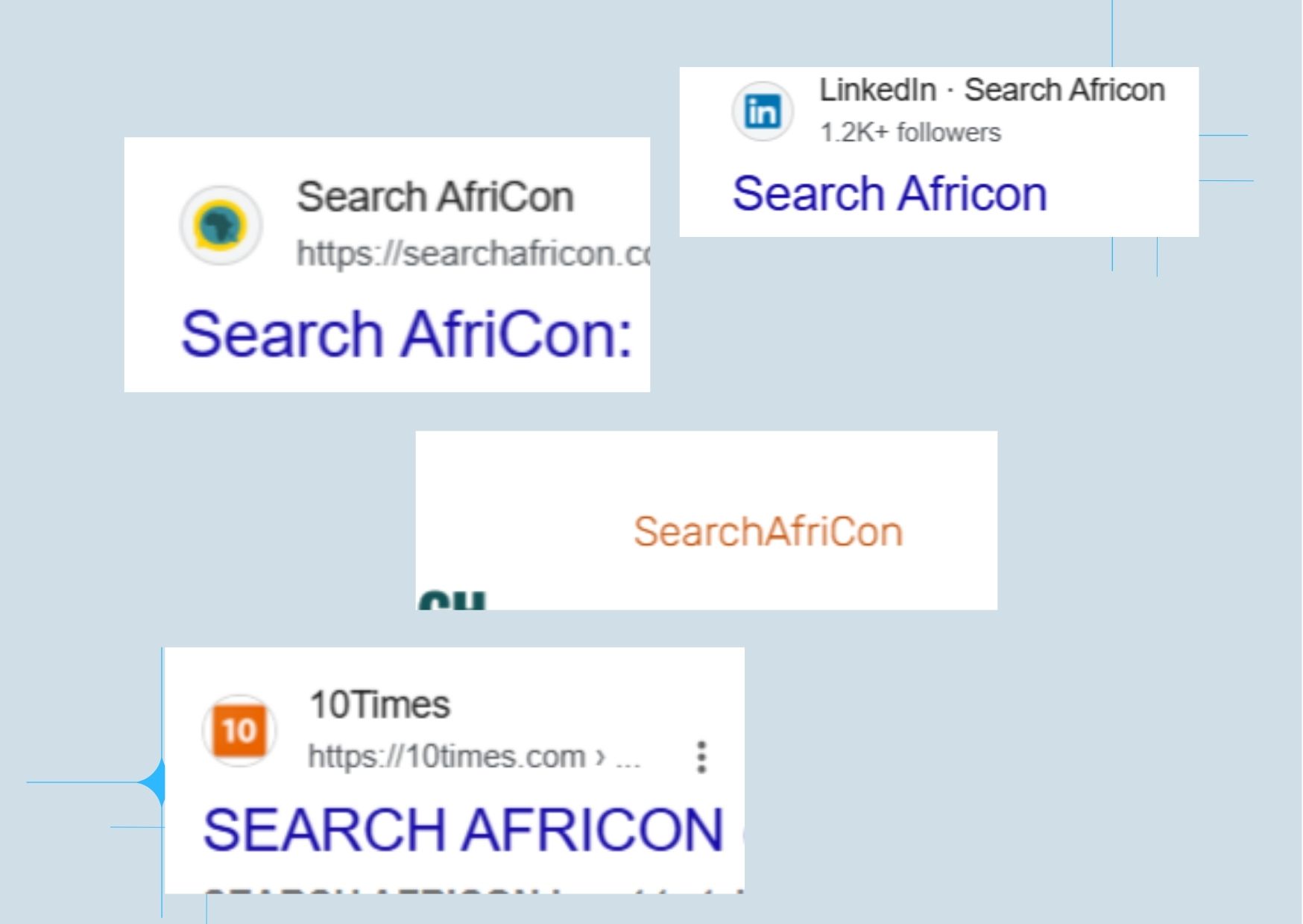
Each variation is understandable in isolation. Collectively, however, they dilute consistency.
Entity resolution systems attempt to determine whether those names refer to one organisation or multiple related entities. Every unnecessary variation increases the amount of reconciliation a machine has to perform before assigning confidence.
In this case, inconsistent editorial decisions create a bigger obstacle to entity consolidation than schema
The strongest entity signals come from repeating the same canonical brand name consistently across:
- page content,
- title tags,
- schema name properties,
- navigation,
- internal anchor text,
- metadata,
- social profiles,
- and external business listings.
Schema should reinforce that consistency, not compensate for its absence.
2. Canonical conflicts split entity authority
Every important entity needs a clear, authoritative home. For an organisation, that's usually the homepage or About page.
Search engines rely on canonical tags, redirects, internal linking, and structured data to understand which URL represents that entity.
When those signals disagree, confidence decreases.
For example, schema may identify one URL as the primary page for an entity while canonical tags point elsewhere, or multiple versions of the same page remain accessible.
These conflicts are almost impossible to identify page by page. They're only visible when you analyse the website as a connected system.
This is exactly the kind of investigation Sitebulb makes possible.
The Canonicals report highlights pages where canonical declarations, redirects, and crawlable URLs disagree. This allows you to identify places where entity consolidation is weakened before those inconsistencies accumulate across hundreds of pages.
The focus should be on giving every important entity a single authoritative home, supported consistently by technical signals.
3. Important entity pages often receive the weakest internal support
The pages carrying strong entity signals - About, speaker, team, sponsor, and community pages - are likely isolated in a site's link architecture. They get published, then gradually disappear from the internal linking strategy.
Schema may identify these pages, but the architecture does not reinforce their importance. Internal links remain one of the strongest signals of both page importance and entity relationships. If your About page contains the clearest description of your organisation but receives very few internal links, you're sending conflicting signals.
The Search Africon audit shifted the focus from whether entities existed to how they were connected.
- Were speakers linked from event pages?
- Did recap articles connect to previous editions? .
- Were sponsors consistently associated with the conference across the site?
- Did the About page reinforce the same organisational identity described elsewhere?
These questions test whether the site's architecture supports the relationships the schema declares. Sitebulb's Internal Links report makes those gaps visible by highlighting entity pages with low inlink counts.
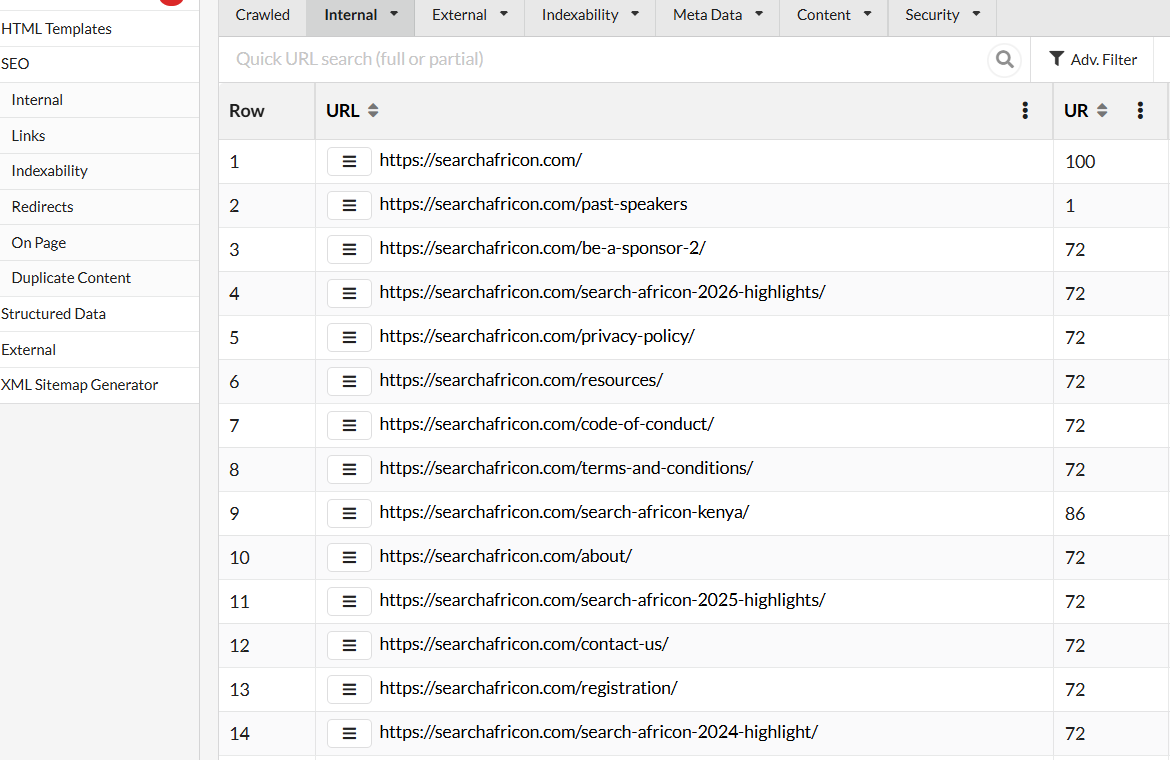
Before adding more schema, strengthen the pathways between your key entity pages. When content, internal links, and structured data reinforce the same relationships, machines build a much clearer understanding of your brand.
How to Audit Your Entity Signals Using Sitebulb
The previous section explored why entity signals become fragmented and why structured data reflects those problems. Now, let's turn those observations into a practical workflow.
Keep in mind that an entity audit reveals the story your website tells about your brand, not just the warnings in a crawl. Then, determine whether machines can confidently follow that story, and prioritise the issues that affect entity understanding.
You should know that not every structured data warning deserves a fix. Some findings from the Search Africon audit represented implementation opportunities.
Others were recommendations, while others reflected how WordPress plugins model schema internally. Without validation, it's impossible to know which category an issue belongs to.
That's why I believe every entity audit should move through six stages: Crawl → Validate → Classify → Prioritise → Implement → Verify
Each stage builds on the previous one, gradually narrowing broad crawl observations into practical actions. Before you begin, make one important check:
Confirm that your structured data exists in the raw HTML returned to crawler, not only after JavaScript executes.
Many About pages, Team pages, speaker profiles, and event templates rely heavily on client-side rendering. If schema is injected after page load, crawlers may not see the same markup that appears in the browser.
Sitebulb supports JavaScript rendering, but your crawl configuration determines what it can evaluate. Always verify those settings before interpreting your Structured Data report.
Step 1: Map the entity landscape before changing anything
The Structured Data Overview is the best place to begin, because it tells you what exists.
Before touching a single page, you need to understand the entity vocabulary your website is already exposing.
Start by mapping what already exists: which schema types appear, how consistently they're deployed, and how many URLs contain structured data.
The Search Africon crawl highlighted several important observations. It contained thousands of Event entities, thousands of Person entities, and Organisation, Article, Logo, BreadcrumbList, and other supporting schema types.
At first glance, the Event warnings appeared alarming, but those numbers alone didn't tell the whole story. They simply highlighted where further investigation was needed.
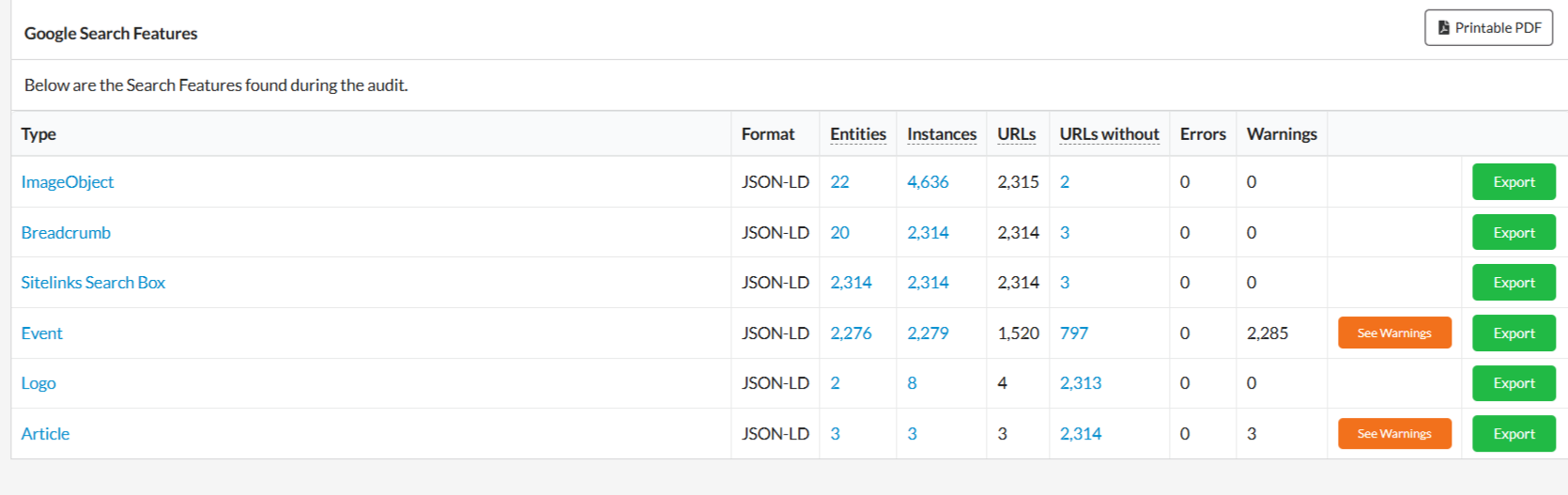
This is why the first question should not be:
"How do I fix these warnings?"
Instead ask:
"Does the entity model represented by these schema types match the story my website is trying to tell?"
For example:
- A SaaS company without SoftwareApplication schema may be under-describing its product.
- A conference website without Event schema is missing one of its primary entities.
- A consulting firm with no Person entities for its consultants may be hiding valuable expertise.
The overview provides the map, and the investigation comes next.
Step 2: Validate the crawl before remediation
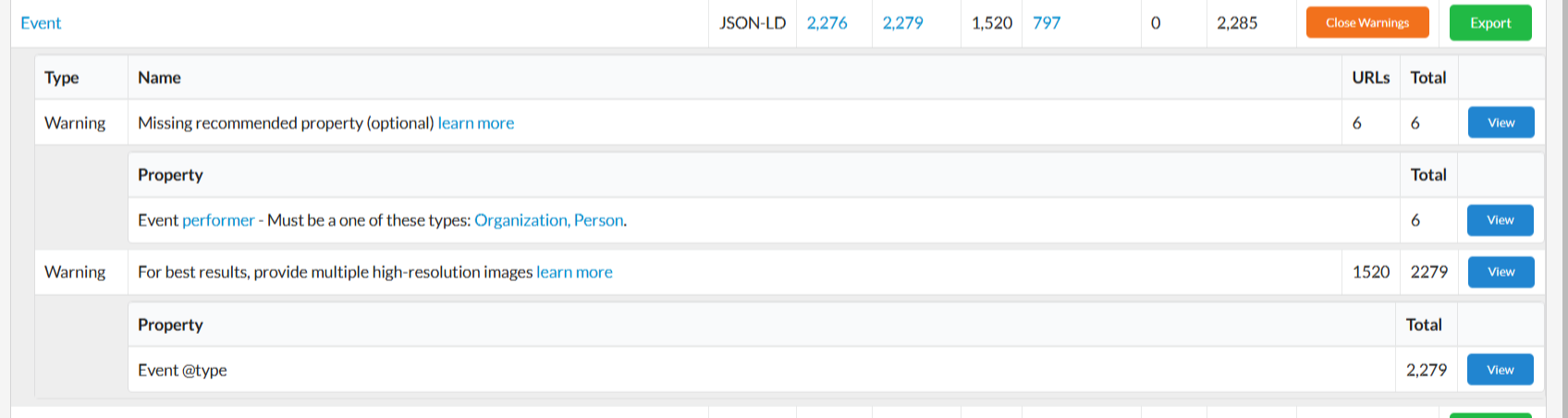
Search Africon Structured Data overview reported 2,276 event entities accompanied by over 2,285 warnings. At first glance, that looked like a widespread implementation problem.
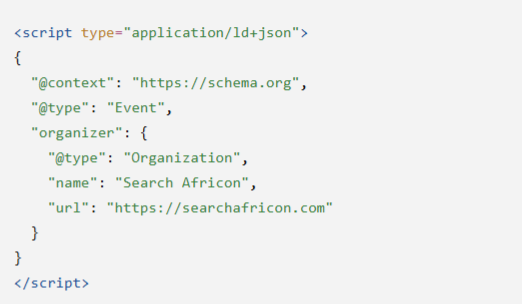
Reviewing the raw JSON-LD showed that the ‘organizer’ property was already being output correctly as an Organization.
The remaining warnings were recommendations, such as additional event images. Then there were limitations of the WordPress plugins generating the markup rather than broken schema.
Rather than treating every warning as something to fix, the audit became an exercise in separating implementation issues from CMS limitations and lower-priority recommendations.
Whenever Sitebulb surfaces a significant cluster of warnings, validate crawl findings before remediation:
- Open the live page and inspect the raw HTML and source code
- Validate the JSON-LD
- Review your WordPress or CMS configuration
- Compare the live implementation with the crawl findings
- Decide whether the issue is a configuration problem, a content problem, or a platform limitation (more on issue classification in step five).
Only then should remediation begin.
Step 3: Audit entity consistency across the site
Once you've validated the crawl findings, shift your attention from individual pages to consistency.
Machines evaluate how consistently an entity is described everywhere it appears. Review your Organisation schema.
Does every instance use the same:
- organisation name,
- homepage URL,
- logo,
- description,
- social profile references?
Then move beyond schema.
Does the same brand name appear consistently across your navigation, title tags, footer, About page, and metadata?
During the Search Africon audit, one of the recurring themes was the importance of consistent entity representation across multiple surfaces.
Small naming variations are easy for people to ignore, but machines don't ignore them. They attempt to reconcile them. Reducing unnecessary variation makes that reconciliation easier.
Step 4: Compare structured data with site architecture
Don't treat structured data separately from site architecture, because search engines don't.
A page may contain an excellent Organisation schema, but if it's buried four clicks deep with very few internal links, the site's architecture sends a conflicting message.
The structured data says: "This page is important."
The navigation says: "Are you sure?"
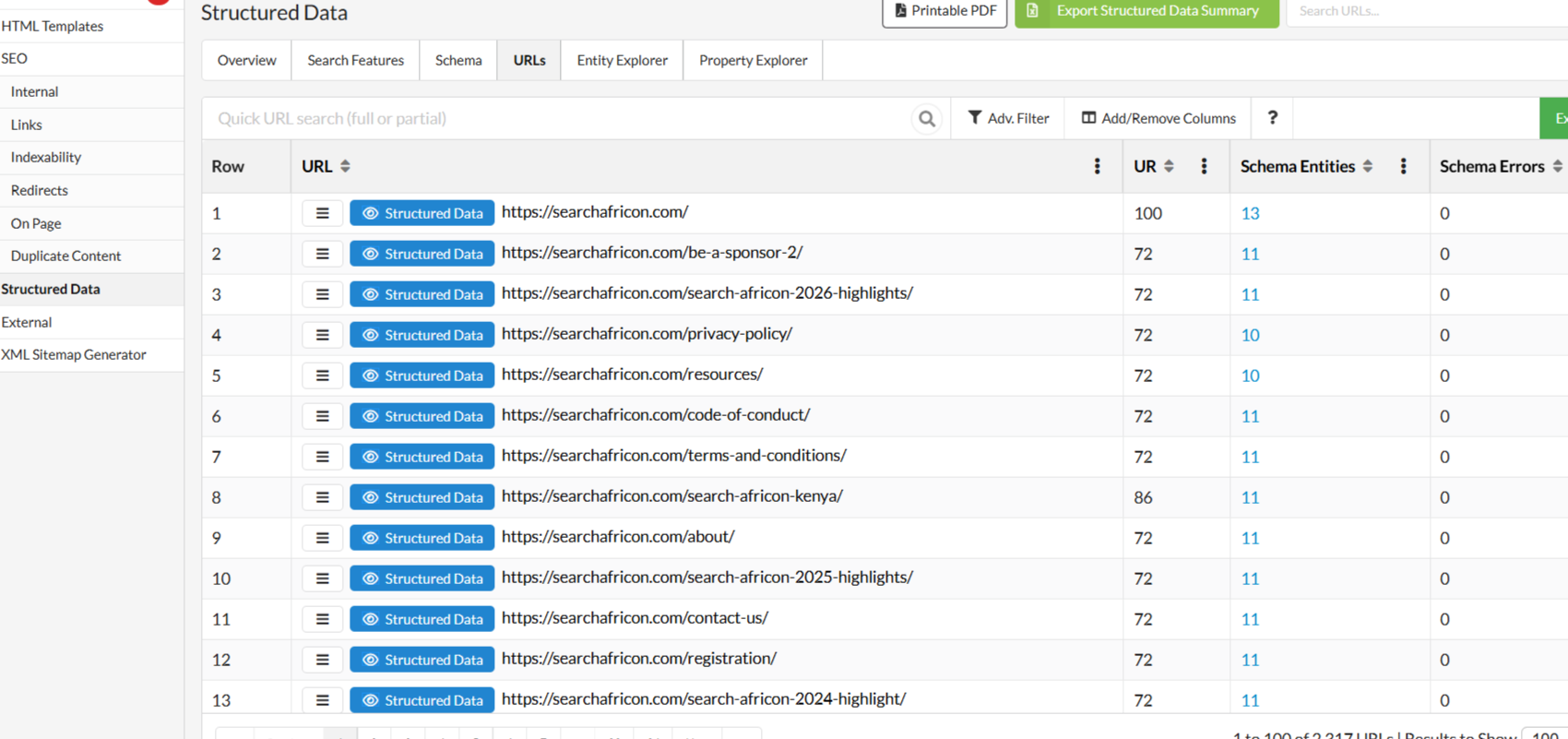
Sitebulb makes these contradictions visible. It helps you identify pages carrying structured data, then sort them by internal inlinks.
Pay particular attention to pages that define your primary entities:
- homepage,
- About page,
- speaker pages,
- product pages,
- service pages,
- event hubs.
These pages should not only contain rich structured data. They should also receive strong internal reinforcement through navigation, contextual links, and logical crawl depth.
Entity understanding is strengthened when content architecture supports the same relationships that structured data describes.
Step 5: Classify before you prioritise
Not every issue uncovered during a crawl deserves the same response. You might just spend a whole lot of time trying to fix what isn't broken (like I did)
One of the outcomes of the Search Africon investigation was realising that every finding fell into one of four categories.
Configuration issues
These can usually be resolved inside WordPress or your CMS.
Examples include:
- missing organisation details,
- incorrect logos,
- inconsistent naming,
- incomplete metadata,
- event organisers that haven't been assigned.
These are generally quick wins.
Content and architecture issues
These require improving how entities are described and connected.
Examples include:
- weak About pages,
- inconsistent brand references,
- missing speaker context,
- poor internal linking,
- disconnected event history.
These improvements strengthen the relationships machines build between entities.
Plugin limitations
Some warnings originate from the way plugins generate schema.
During the Search Africon audit, several Event warnings fell into this category. The Events Calendar Free plugin does not expose properties such as performer information or multiple schema image variations through its interface.
Trying to "fix" those warnings from the WordPress dashboard wasted my time because there is nothing available to configure.
If you ever wear this shoe, decide whether those enhancements justify custom schema development.
Development work
Some improvements require code.
Examples include:
- extending schema graphs,
- custom relationship properties,
- advanced entity linking,
- bespoke JSON-LD,
- plugin overrides.
These should only be prioritised after configuration and content improvements have been completed.
Step 6: Verify the Implementation
The crawl is not finished when you publish changes. Confirm that the changes are visible to crawlers.
Run another Sitebulb crawl and compare it with the previous one. Rather than chasing a lower warning count, ask questions such as:
- Did the intended pages receive the expected structured data?
- Have naming inconsistencies been removed?
- Are canonical issues resolved?
- Are entity pages receiving stronger internal support?
- Has the architecture improved?
Confidence is the objective, not perfection.
Some warnings may remain because they're recommendations or plugin limitations, that's acceptable. The important thing is you know why they remained.
Five questions to ask before every entity audit
Before opening Sitebulb or any crawler, ask yourself these questions. They quickly reveal whether your website is likely to present a coherent entity story.
- Does every important entity have one clear, authoritative home page?
- Is the brand described consistently across content, navigation, metadata, and structured data?
- Do internal links reinforce the pages that define the organisation, products, services, events, and people?
- Have the crawl findings been validated against the live implementation before being treated as problems?
- Can every issue you identify be classified as a configuration issue, a content issue, a plugin limitation, or a development task?
If you can confidently answer those questions, you'll spend far less time chasing crawl warnings. And more time improving the signals that shape how AI systems understand your brand.
What entity alignment unlocks for AI search
Everything we've covered so far, consistent naming, stronger internal architecture, canonical clarity, structured relationships, and validating crawl findings, points towards one goal.
Passing Rich Results tests and reducing Sitebulb warnings are useful, but they are not the goal. What matters is helping machines build enough confidence in your brand to characterise it, connect it to related entities, and confidently reference or cite it.
Search engines and AI systems are constantly deciding whether they understand an organisation well enough to include it in generated answers. They reach that decision by combining signals from across your website and other trusted sources rather than relying on a single page or schema type.
When those signals reinforce one another, confidence grows. When they conflict, or important relationships are missing, that confidence weakens. The result is uncertainty not error messages, and uncertainty rarely earns citations.
Entity alignment reduces that uncertainty. Not by guaranteeing appearances in AI Overviews or AI-generated answers. But by reducing the ambiguity machines must resolve before deciding whether your brand is trustworthy enough to describe, connect, and represent. It ensures machines encounter one consistent story instead of several competing ones. That's a prerequisite for trust.
Sitebulb's role doesn't end after the first crawl
E ntity signals drift. New events are published, templates change, plugins update, etc
Without regular validation, yesterday's coherent entity graph gradually becomes tomorrow's fragmented one.
That's why you shouldn't view Sitebulb as a schema checker, but treat it as an ongoing monitoring tool (pal).
After major content releases, run another crawl and compare it with your previous baseline.
Ask questions such as:
- Are new entity pages receiving sufficient internal links?
- Are the organisation details still consistent?
- Has the number or type of structured data warnings changed?
- Are new templates generating the expected schema?
- Have recent changes introduced contradictions elsewhere on the site?
The idea is to achieve a coherent story about your entities as your website grows, not neessarily a crawl with zero warnings.
Wrap up
I started this audit expecting to investigate schema. Instead, it became an investigation into how a website communicates its identity to machines.
That shift changed the entire direction of the analysis. The question became whether every technical and content signal across the site reinforced the same understanding of the same organisation.
Entity alignment doesn't begin with structured data, and it doesn't end there. It begins with a clear organisational identity, consistent naming, logical site architecture, meaningful internal relationships, and content that tells the same story across every important page. Structured data then becomes the machine-readable expression of that story, not a substitute for it.
Search engines and AI systems are trying to understand your brand. Every crawl is an opportunity to ask whether your website is making that job easier or harder.

Sitebulb is a proud partner of Women in Tech SEO! This author is part of the WTS community. Discover all our Women in Tech SEO articles.

Chioma Anunobi is an SEO and Content Engineer with three years of experience helping SaaS and marketing brands build a stronger search presence. She enjoys using storytelling to simplify complex SEO concepts and help brands connect with the right audience.

Related Articles
 Technical SEO Audit Reports: How to Turn Them into Client Retention Tools

 Enterprise SEO Audit: From Crawl to Prioritised Action Plan

 Which Rendering Approach is Best for SEO on E-commerce Sites?

 Sitebulb Desktop
Find, fix and communicate technical issues with easy visuals, in-depth insights, & prioritized recommendations across 300+ SEO issues.
- Ideal for SEO professionals, consultants & marketing agencies.
 Sitebulb Cloud
Get all the capability of Sitebulb Desktop, accessible via your web browser. Crawl at scale without project, crawl credit, or machine limits.
- Perfect for collaboration, remote teams & extreme scale.