

 Kelly-Anne Crean
This week, we're grateful to Kelly-Anne Crean who shares a practical framework for measuring technical SEO debt by commercial impact—turning an overwhelming audit backlog into a prioritised plan that actually gets fixed.
Most technical SEO audits uncover more issues than any team can realistically fix immediately.
A crawl might reveal thousands of URLs with problems ranging from duplicate content and indexation concerns to internal linking issues and performance gaps. The challenge is rarely finding problems. It’s deciding which problems matter most, getting the right people involved, and turning recommendations into meaningful improvements.
This is where technical SEO debt comes in.
This article covers how to move beyond identifying issues and create a practical approach for measuring, prioritising and reducing technical debt.
Contents:
- Introduction to technical SEO debt
- What technical SEO debt actually is and how it accumulates
- How to distinguish between issues that matter and those that don't
- A framework for scoring and prioritising technical debt
- How to get technical SEO recommendations implemented
- What gets over-prioritised and what gets missed
- Building a remediation roadmap
- Preventing technical SEO debt from building again
- Putting it into practice
Introduction to technical SEO debt
Technical SEO debt is not simply a list of errors found during an audit. It represents the accumulation of technical decisions, compromises and missed opportunities that make a website harder to crawl, understand and maintain over time.
Like technical debt in software development, it is often created for understandable reasons. A team may need to launch a new feature quickly, migrate platforms under tight deadlines, or prioritise functionality over long-term SEO considerations. These decisions may be the right choice at the time, but without ongoing management, small compromises can become bigger challenges.
The problem is that this kind of debt is often treated as a checklist exercise. Teams identify issues, create a backlog, and attempt to work through them in order. This approach can result in significant effort being spent on low-impact improvements while higher-value opportunities remain unresolved.
The first question I ask when reviewing a backlog is rarely "how severe is this issue?" It is "what happens to revenue, leads and conversions if we don't fix it?"
Does it affect the products that generate the highest-revenue? Its best-performing category pages? The landing pages that consistently generate leads? Or is it confined to legacy content that contributes little to organic visibility or commercial performance?
Here is an honest truth that most SEO articles avoid: a large proportion of what appears in a typical technical audit will not directly generate more revenue if fixed. That does not mean those issues should be ignored. It means they should not be at the top of the list.
Technical SEO is ultimately about making informed investment decisions. A perfect audit score isn’t the objective. The real priority is finding the improvements that protect revenue, strengthen customer journeys and support long-term growth.
In this article, we’re going to cover:
How it builds up over time
How to separate important issues from low-impact findings
A practical scoring framework with a worked example
How to communicate recommendations and get them implemented
How to build a remediation roadmap and prevent debt from accumulating again
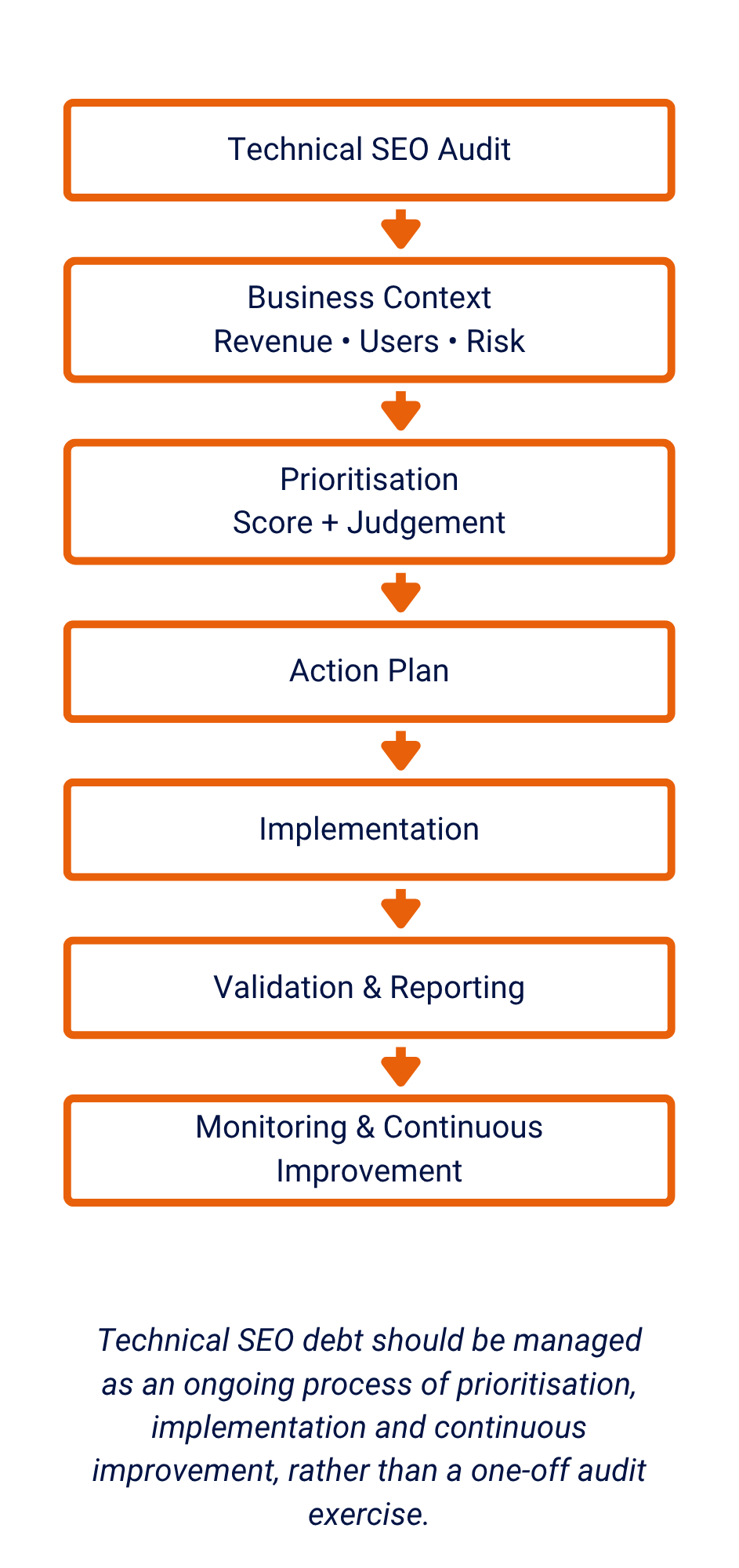
What technical SEO debt actually is and how it accumulates
Technical SEO debt is the gap between the current technical state of a website and the ideal state required to support organic visibility, user experience and long-term growth.
It is important to distinguish between a technical issue and technical debt. A technical issue is an individual problem, such as a missing canonical tag, an incorrect redirect, or a page that cannot be crawled. Debt is the wider impact created when these issues accumulate, remain unresolved, or create ongoing limitations for a website.
How it builds over time
Debt can develop even on well-managed websites. It is rarely caused by one major mistake. More often, it comes from a series of smaller decisions made over time.
Common causes include:
New templates launched without SEO requirements being considered
Platform limitations creating ongoing technical challenges
Features added without considering crawlability or indexation
Multiple teams making updates without shared SEO governance
Large websites are particularly vulnerable because they often involve multiple stakeholders, complex technology stacks and frequent changes. Often, the decision itself is understandable. The problem is that there isn’t always a process to identify and manage the SEO impact before it starts affecting revenue.
Why fixing every audit finding is not the answer
A common mistake is treating an audit as a to-do list. While audits are essential for identifying opportunities, they do not automatically tell you which issues have the biggest commercial impact, which pages matter most, or which problems should be deprioritised.
A website with 10,000 technical findings does not necessarily have 10,000 urgent problems. I have worked with clients who have spent months working through audit backlogs fixing minor issues while the problems most likely to affect their revenue remained unresolved. The SEO’s role goes beyond identifying issues. We need to understand which ones actually matter to the business and where our time will have the greatest impact.
How to distinguish between issues that matter and those that don't
Not every issue in an audit deserves the same level of attention. Effective technical SEO is not about eliminating every warning or achieving a perfect audit score. It is about identifying the issues that create the greatest risk or opportunity for the business.
Context matters as much as the issue itself
The impact of a technical issue depends on several factors:
the number of pages affected,
the importance of those pages,
their role in the customer journey,
their contribution to revenue or leads, and
the effort required to resolve the issue.
It is also important to think beyond individual URLs. Customers rarely arrive on a website and convert immediately. They move through a journey that may begin with an informational article, continue through a category or service page, and end on a product or enquiry page.
A technical issue affecting any stage of this journey can reduce commercial performance, even if the problem does not exist on the final conversion page. This is why prioritisation should consider the entire customer journey, not just the pages that generate revenue directly.
The same technical problem can have very different levels of importance depending on where it appears.
A rendering issue affecting a category template that drives significant organic traffic is a priority.
The same rendering issue on an old section of a website, that is no longer maintained, may not justify immediate development resource.
A problem on a money page is urgent. The identical issue on a legacy page you are about to retire can wait.
The hidden cost of JavaScript and rendering
One area where I see technical debt consistently underestimated is JavaScript rendering. For those of us who were doing SEO in 2016, this will feel familiar.
Back then, Googlebot was only just beginning to render JavaScript reliably, and the advice was clear: make sure your important content is in the HTML. In 2026, that advice has become relevant again because many AI crawlers appear to rely primarily on the initial HTML response they receive rather than executing client-side JavaScript in the same way as Googlebot.
Recent testing continues to support the view that major AI crawlers do not process JavaScript in the same way as Googlebot. Vercel and MERJ’s analysis of over 500 million GPTBot requests found no evidence of JavaScript execution, and independent 2026 testing of GPTBot, ClaudeBot and PerplexityBot has reported similar behaviour.
This means important content, internal links, navigation or metadata that only become available after JavaScript executes may be harder for AI systems to discover or interpret. As a practical rule of thumb, if important content is not present in the raw HTML returned by View Source, it is less likely to be accessible to many AI crawlers. This observation is supported by Google's guidance that server-rendered or pre-rendered HTML remains beneficial because not all bots execute JavaScript.
Googlebot differs because it uses an evergreen Chromium-based rendering engine as part of its crawling and indexing pipeline. Google first crawls the HTML, then queues pages for rendering and executes JavaScript before processing the rendered HTML for indexing and link discovery.
The practical implication is that a website may perform well in traditional Google Search while exposing significantly less content to AI crawlers that primarily rely on the initial HTML response. As AI-driven discovery continues to grow, ensuring critical content, internal links and structured data are available in the initial HTML response is becoming increasingly important.
I have worked on websites where product descriptions and category navigation were all rendered via JavaScript. On the surface, everything looked fine. In practice, important commercial pages were being missed or indexed incorrectly for months before it was identified.
Editor's Note: You can learn all about how JavaScript rendering impacts visibility in our JavaScript SEO hub.
Considering AI search alongside traditional SEO
Technical SEO teams now need to consider how issues may affect AI-powered search experiences alongside traditional search engine visibility.
The same factors that influence crawling, indexation and content understanding also affect how AI systems discover and interpret content. When evaluating the backlog, it is worth asking: could this issue prevent important content from being discovered or rendered correctly by AI systems? Could it affect how authoritative content is retrieved or cited?
Structured data is a good example. Correct schema markup on key commercial pages, products, services, reviews and organisations helps both search engines and AI systems understand what a page is about and how it relates to other content. Incorrect or missing schema on high-value templates is often underestimated because it does not trigger obvious errors in audit tools. But it can reduce the clarity of signals available to both traditional search and AI-driven experiences.
Poor internal linking can similarly limit how easily AI systems discover important content. A well-structured internal linking strategy ensures that the pages most important to revenue are also the most accessible to crawlers and AI systems.
AI search should not replace existing prioritisation methods, but it adds another dimension when assessing whether a technical issue is worth fixing.
A framework for scoring and prioritising technical debt
A prioritisation framework transforms a large audit backlog into a practical action plan. Rather than relying on opinion or the order issues appear in a crawl report, each issue can be assessed against consistent criteria.
The scoring model
The model below is one I use when working through technical audits with clients. Each factor is scored from one to five, where one represents low impact or low effort and five represents high impact or high effort.
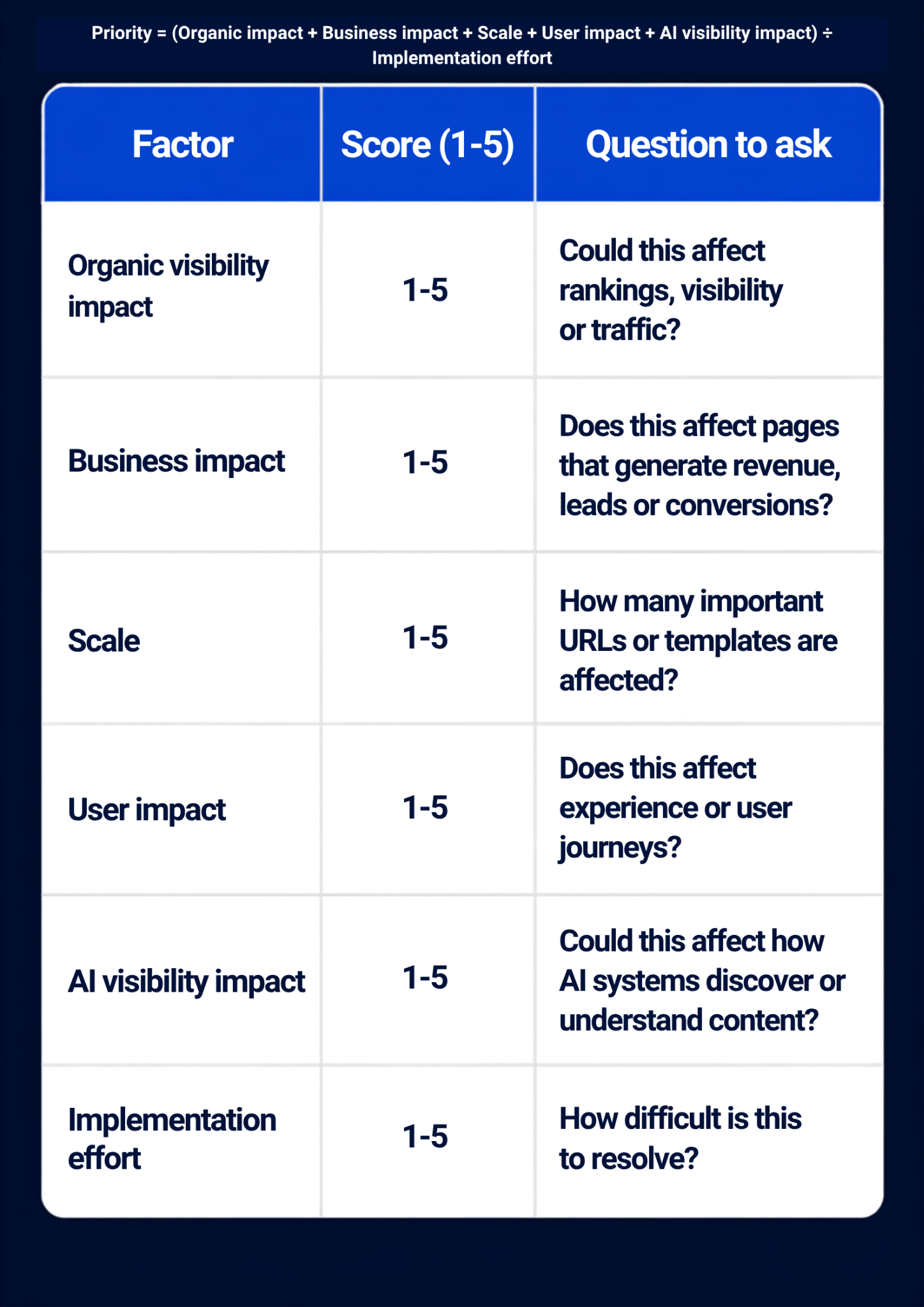
A higher score indicates a higher priority. Issues with a high combined impact score and low implementation effort rise to the top naturally.
The business impact factor deserves particular attention. When scoring this, I think specifically about revenue, leads and conversions. Does this issue affect pages that generate sales? Landing pages that drive enquiries? Category pages that funnel customers towards products? If the answer is no, the business impact score should reflect that honestly.
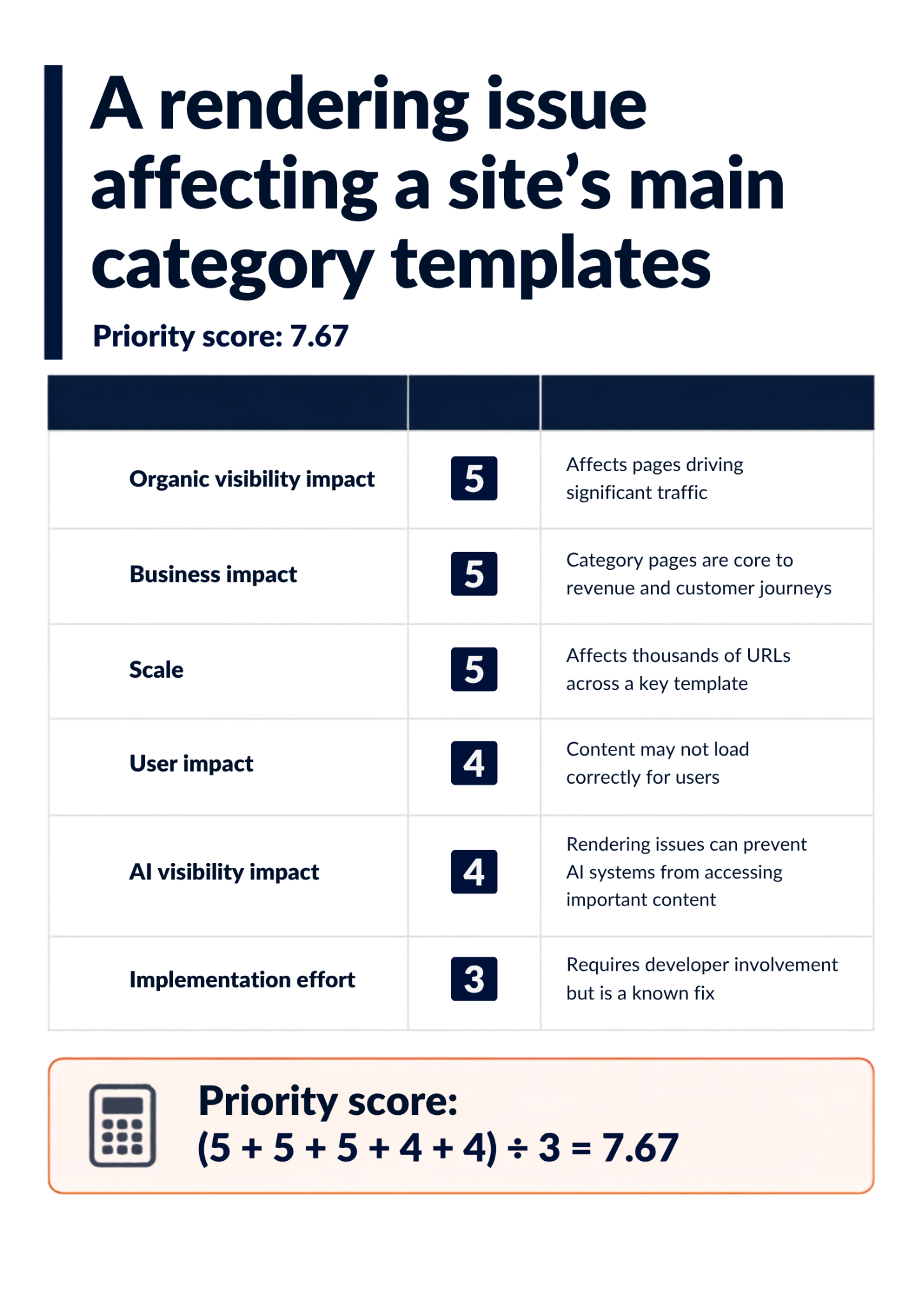
Worked example: high-priority issue
Worked example: low-priority issue
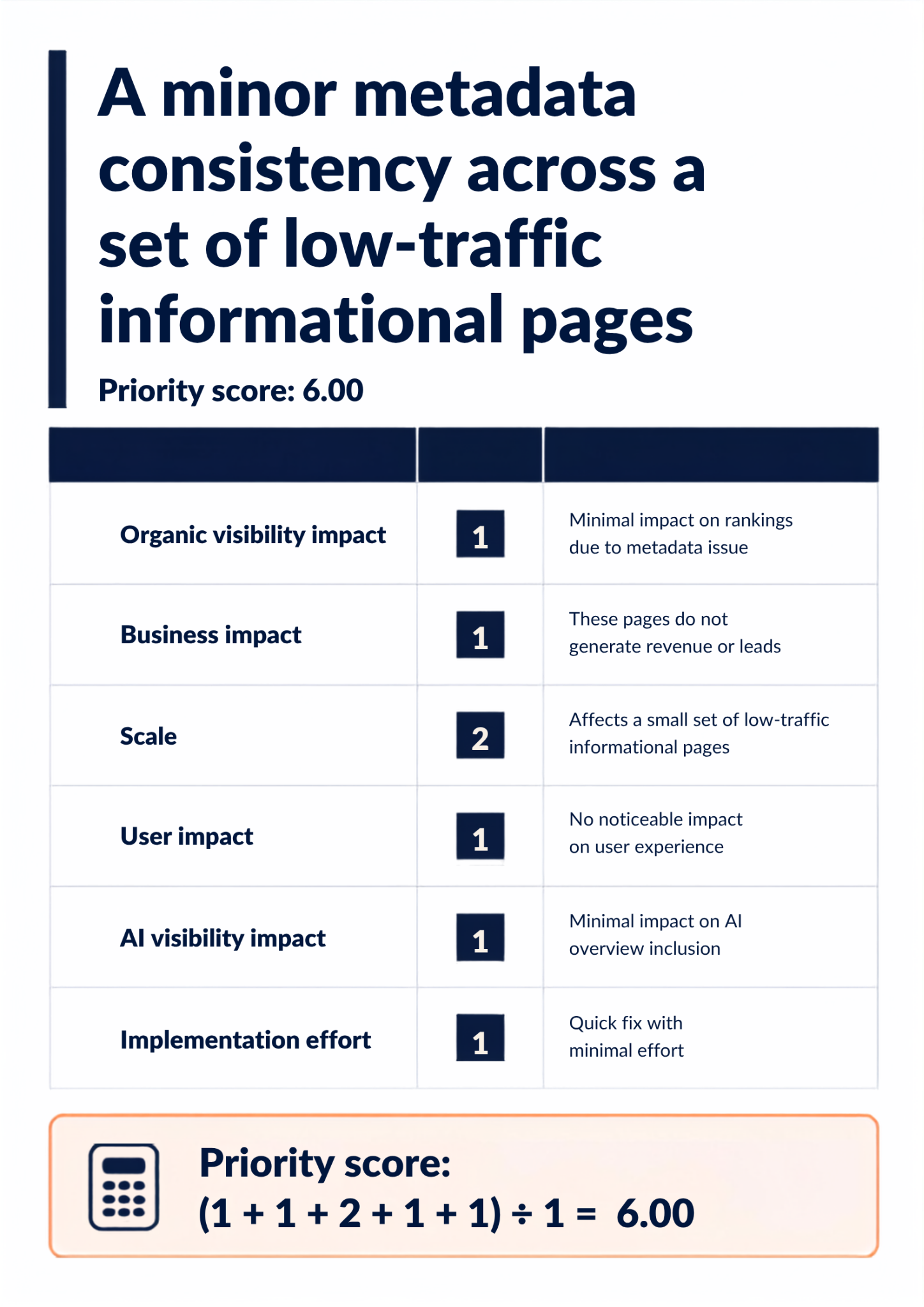
The scores appear close, but the business impact difference tells the real story. The rendering issue on core templates carries direct revenue risk. The metadata issue does not. The numbers are there to make the conversation easier, not to make the decision for you. Professional judgement still matters, particularly when you’re weighing commercial priorities against development constraints.
Working agency-side, I have seen technical SEO audits uncover thousands of findings across large, complex websites. The biggest challenge is rarely finding problems. It is helping clients understand which issues deserve attention first and where development resource will create the greatest return.
Consider the opportunity cost
Every hour spent resolving low-value issues is an hour that cannot be invested elsewhere.
Development resource is finite. Prioritising minor improvements on pages with little commercial value may delay work that improves the discoverability of best-selling products, strengthens important category pages or removes barriers within key conversion paths.
A useful question before creating a development ticket is: if we do not fix this in the next three months, what is the likely impact on revenue, leads or conversions?
If the answer is very little, it probably should not be at the top of the backlog. If the answer is that it could cost the business visibility on its highest-performing pages, the priority becomes much clearer.
How to get technical SEO recommendations implemented
Finding issues is only the first step. The real value comes from getting the right improvements delivered.
One of the most common frustrations I see agency-side is that technically correct recommendations aren’t actioned on. I’ve seen technically sound recommendations sit untouched for months because the business case wasn’t clear or the development team had higher priorities.
Frame recommendations around revenue and business outcomes
Development teams are often balancing new product features, security updates, performance improvements and business-critical projects. A recommendation that simply explains what is wrong may not provide enough context for teams to understand why it matters.
Compare these two approaches:
"Thousands of URLs are being indexed unnecessarily due to parameter variations."
versus
"Product filter URLs are being indexed despite having limited unique value. This is creating additional crawl demand and reducing the efficiency with which search engines discover and revisit our most important product and category pages. Resolving this should improve how effectively search engines focus on the pages most likely to drive revenue."
The second connects the issue directly to commercial outcomes. Different stakeholders care about different things. Developers need implementation clarity. Senior stakeholders need to understand revenue risk and expected impact. The most effective recommendations adapt to the audience and frame the issue around money, leads and conversions rather than SEO best practice alone.
Structure recommendations for action
A strong recommendation should clearly define the issue, explain its potential impact on revenue or leads, identify the affected templates or pages, propose a solution, assign ownership and describe how success will be measured.
Without that structure, even the most important technical fixes can get lost in a backlog.
What gets over-prioritised and what gets missed
Knowing what not to prioritise can be just as valuable as knowing what to fix.
Commonly over-prioritised issues
Some issues receive significant attention because they are easy to identify or appear prominently in audit tools. Examples include minor metadata inconsistencies, large numbers of low-value broken links, small validation warnings and issues confined to pages with little organic visibility or commercial value.
These may be worthwhile at some point, but they should not take priority over issues that directly affect revenue-generating pages or key customer journeys. I have seen teams spend weeks on this kind of work while issues affecting their most important commercial pages remained unresolved.
Frequently underestimated issues
Template-level issues can be more significant than thousands of isolated URL issues. If a category page template creates poor internal linking, incorrect metadata or indexation problems, the impact scales across the entire website and can directly affect revenue.
Internal linking influences how search engines and AI systems discover and understand content. Poor structures can limit the visibility of important pages even when they are technically accessible.
Rendering issues mean a page may appear correct visually while still creating problems for crawlers and AI systems. If key content, navigation or internal links are only available after JavaScript executes, important pages may be missed or deprioritised. I have worked on websites where this was silently limiting the performance of core commercial templates for months before it was identified.
Index management problems allow low-value pages to consume crawl budgets that would be better spent on revenue-generating content.
Structured data on key commercial pages is frequently underestimated. Correct Product, Service or Organisation schema helps both search engines and AI systems understand what a page offers and how it relates to commercial intent. Missing or incorrect markup on high-value templates is worth fixing. The same issues on low-value pages are not always a priority.
Building a remediation roadmap
A remediation roadmap moves technical SEO from a reactive process into a structured approach that supports long-term commercial performance. A good roadmap delivers the improvements that protect and grow revenue while making consistent progress over time.
Sequence fixes by commercial impact and effort
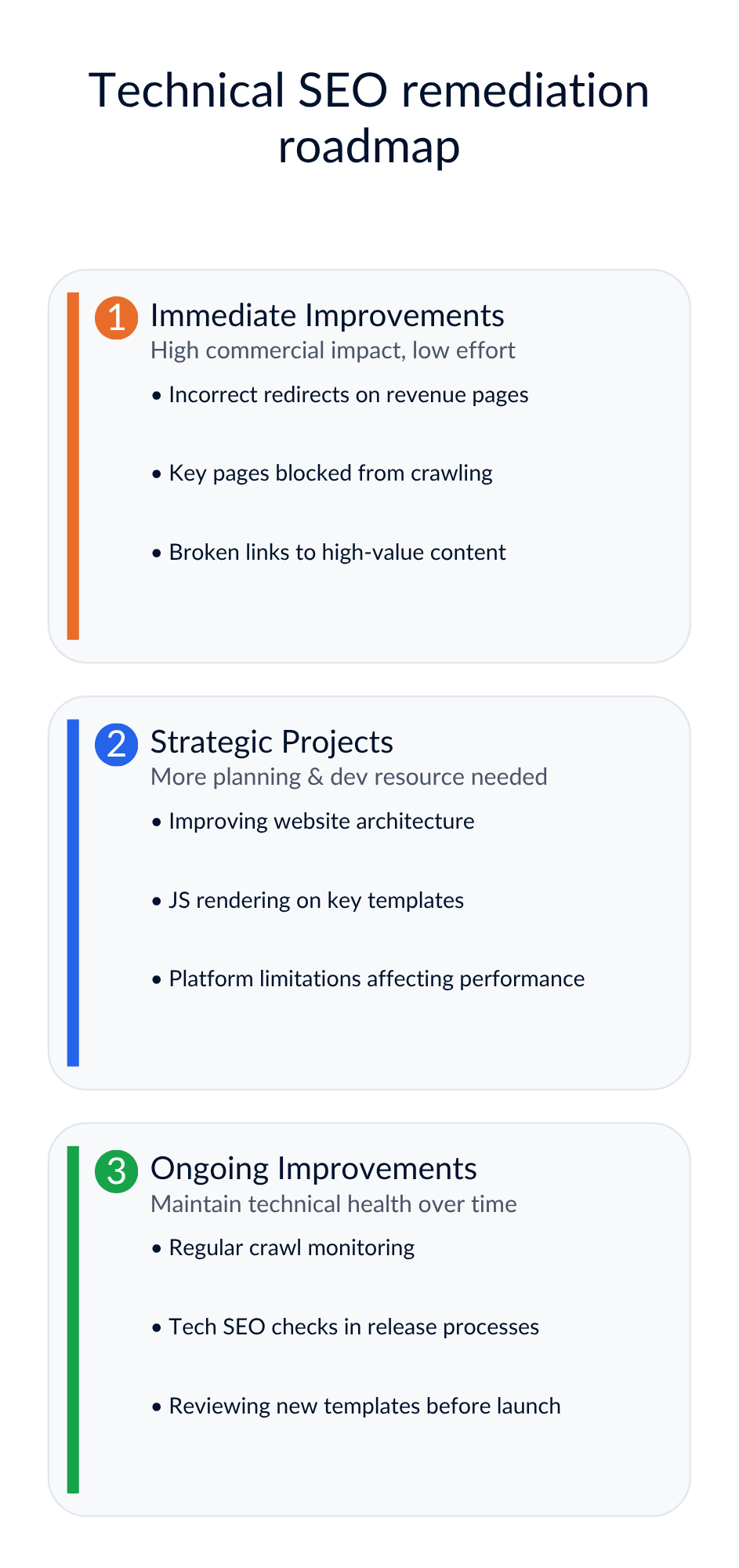
Group the backlog into three categories:
Immediate improvements: high commercial impact, relatively low implementation effort. Examples include incorrect redirects affecting revenue-generating pages, important pages blocked from crawling, indexation issues affecting key commercial templates and broken internal links to high-value content.
Strategic projects: require more planning, development resource or cross-team involvement. Examples include improving website architecture, resolving JavaScript rendering challenges on important templates and addressing platform limitations that affect commercial performance.
Ongoing improvements: changes that maintain technical health over time. Examples include regular crawl monitoring, technical SEO checks within release processes and reviewing new templates before launch.
Group issues by root cause
One of the biggest mistakes when managing a technical backlog is treating every finding as a separate task. Large websites often have thousands of URLs affected by the same underlying cause. Thousands of duplicate URLs may result from one parameter configuration. Widespread internal linking problems may stem from a single architectural decision.
Addressing the root cause is usually more efficient than fixing individual symptoms, and it frees up development resource to focus on issues that matter to revenue.
Report on outcomes, not issue counts
Avoid measuring success only by the number of issues closed. A website can have fewer reported issues without any meaningful improvement, while a single strategic fix can create significant commercial value.
Every recommendation should have an owner, a business justification, an agreed priority, a success metric and a review date. Useful ways to report progress include organic visibility improvements on commercial pages and measurable changes in revenue or lead volume from organic search.
Preventing technical SEO debt from building again
Resolving existing debt is only part of the process. Without changes to how websites are managed, the same problems tend to return.
Technical debt often builds because SEO is considered too late. New features, templates and platform changes introduce challenges that become difficult to resolve after launch. Preventing this requires SEO to become part of ongoing development and maintenance processes.
Practical steps include involving SEO earlier in website projects, reviewing new templates before launch, including SEO requirements in development processes and monitoring website health regularly rather than only during large audits.
Ownership matters too. Someone needs to be responsible for monitoring technical health, reviewing changes and escalating issues before they start affecting revenue. Without clear ownership, technical SEO becomes a cycle of identifying problems without resolving their causes.
Putting it into practice
Technical SEO debt is a business prioritisation challenge. There will always be another issue to investigate, another warning in a crawl and another improvement that could be made. The skill is knowing which ones deserve attention first.
The most important shift is connecting technical decisions to commercial outcomes. Most of what appears in a typical audit will not directly generate more revenue if fixed. The best SEO teams are honest about this, which frees them to focus on the improvements that genuinely protect and grow the business.
The value of a technical fix is determined by the value of the pages it improves. Fix the things that matter to money, leads and conversions first. Manage the rest in proportion to their actual commercial impact.
By treating technical debt as an ongoing process rather than a one-off clean-up exercise, teams can make better investment decisions, reduce future risk and build websites that continue to support sustainable organic growth.

Sitebulb is a proud partner of Women in Tech SEO! This author is part of the WTS community. Discover all our Women in Tech SEO articles.

Kelly-Anne is the Head of Operations at Koozai, with over 16 years of marketing and SEO expertise. She is dedicated to mentoring women in tech SEO, providing guidance and support to help them develop essential skills and achieve their career aspirations.

Related Articles
 Technical SEO Audit Reports: How to Turn Them into Client Retention Tools

 Enterprise SEO Audit: From Crawl to Prioritised Action Plan

 Which Rendering Approach is Best for SEO on E-commerce Sites?

 Sitebulb Desktop
Find, fix and communicate technical issues with easy visuals, in-depth insights, & prioritized recommendations across 300+ SEO issues.
- Ideal for SEO professionals, consultants & marketing agencies.
 Sitebulb Cloud
Get all the capability of Sitebulb Desktop, accessible via your web browser. Crawl at scale without project, crawl credit, or machine limits.
- Perfect for collaboration, remote teams & extreme scale.