

Is AI Killing Publisher Search Traffic? What The Guardian and Telegraph Think
 Jojo Furnival
Published May 19, 2026
In publishing SEO circles right now, "AI did it" has become the default explanation for a lot of traffic decline. AI overviews are eating SERP real estate, zero-click is accelerating, and the value exchange that made Google work for publishers is collapsing. However, it's not the whole story. If you stop at "AI did it," you miss the more uncomfortable diagnosis that lies beneath.
That's roughly where Jessie Willms and Harry Clarkson-Bennett landed in our recent Sitebulb webinar. Jessie is SEO editor at The Guardian US and co-founder of the WTF is SEO newsletter. Harry is former SEO director at The Telegraph and author of the Leadership in SEO newsletter. Between them, they cover pretty much every configuration a publishing SEO might find themselves in: open vs paywalled, US-facing vs UK, subscription-first vs reader-contribution model.
Some really useful insights and frameworks emerged from their discussion—for loyalty, for content strategy, and for what the SEO role actually looks like when search isn't the centre of the universe anymore.
Contents:
- The audience was already leaving, AI just made it harder to ignore
- The economics don't work anymore
- What content is actually worth producing now
- A framework for measuring loyalty
- The SEO role is expanding, hooray!
- On paywalls, AI, and the bot-blocking question
- So, is AI killing publisher search traffic?
- TL;DR key takeaways
The audience was already leaving, AI just made it harder to ignore
If you had to name the single biggest threat to publisher traffic in 2026 – and AI wasn't allowed to be the answer – what would you say?
Harry's answer is that younger audiences have been switching off from the traditional publisher offering for a while, which has created the "reverse halo effect." It used to be that working for a big brand gave individual journalists credibility. Now it's increasingly the other way round: publishers need to work with and leverage the trust that individual creators build with their audiences.
The brand needs the person more than the person needs the brand.
Jessie names two things: fatigue and fragmentation. News fatigue being the daily onslaught of headlines that don't make you feel great about the world (I mega-relate), leading people to opt out of news entirely rather than just switching sources. And fragmentation referring to user attention being scattered across TikTok, Instagram, YouTube, Substack, podcasts.
Publishers aren't losing to a single competitor. They're losing to a million of them simultaneously.
The uncomfortable part is that search was masking both of these problems. Traffic was coming in through Google, the numbers looked okay, and the underlying audience drift didn't seem urgent. Then search started declining and there was nowhere left to hide.
Reuters Institute research backs this up: 18-24s mostly encounter news incidentally now, through feeds rather than through active search or direct navigation. Harry cites figures suggesting over-55s spend nearly 20 minutes a day on news websites while under-25s spend around four minutes. I couldn’t verify these figures but I think we get the overall point: the older audience is reading; the younger audience is fact-checking something they saw somewhere else.
Jessie Willms is fairly honest about where this could lead. She'd like to believe that younger audiences will age into active search behaviour as their lives get more complex (mortgages, retirement savings, the kind of stuff that sends you to a reliable source). Maybe they will. But if you've been trained from a young age to get information passively via your platform of choice’s algorithm, it's probably optimistic to assume a switch will flip at some point.
"I'm gonna kinda hope for that," she says. I think we all hope for that.
Because this matters beyond publishers. Any content business that built its audience primarily through search is facing some version of this. The search-first model assumed people would keep actively seeking information. They're seeking it less, and increasingly somewhere other than Google.
The economics don't work anymore
Even if the audience hadn't started drifting, the economics of publisher SEO would still be in trouble, says Harry.
Google raised the quality bar on content. That’s a good thing, but quality content is more expensive to produce. Simultaneously, AI overviews, zero-click results, and shrinking SERP real estate reduced the reward you get from ranking. So every year, the cost goes up and the return goes down.
The manual actions for parasite SEO made this worse. Big publishers had been ranking for almost anything – content well outside their editorial lane, pure keyword plays with no particular brand justification – because Google's algorithm rewarded domain authority over relevance.
When the helpful content update didn't fix this algorithmically, Google went heavy-handed with manual actions instead. The result: A lot of content that was only ever justified by search volume is now a liability, and publishers are sitting on sprawling content archives full of it.
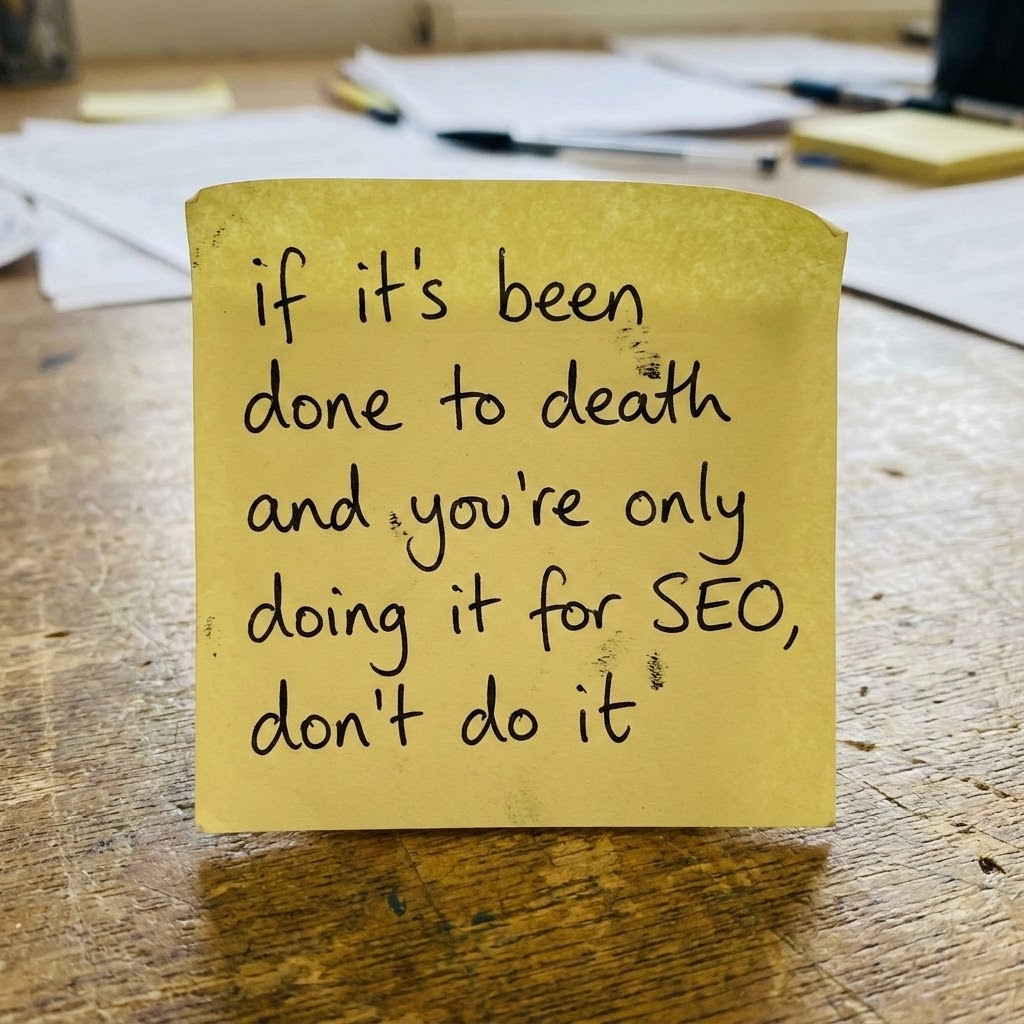
Harry's rule of thumb on this is worth writing on a Post-it: if the content has been done to death and you’re only doing it for SEO, don't do it. If your only reason for creating it is that it has 50,000 searches a month, stop. You'd probably be better off as a business without it.
The pruning problem is real, though. On a regular website, you can just kill underperforming content. But inside an enterprise-scale publisher, editorial relationships, commissioning structures, and sign-off processes make this super-complex. The SEO team doesn't control the content archive in the way a head of SEO at an ecommerce brand might.
And another thing: Affiliate is "way harder" now (Harry's words), and that was a lucrative business line. Direct traffic has also declined. So it's not just organic search. The whole traffic mix is under pressure all at once.
Zero-click, Harry points out, has actually been happening for years. Featured snippets, knowledge panels, and People Also Ask were all eroding publisher click share long before AI overviews arrived. What AI has done is accelerate and formalise a trend that was already well established.
The value exchange that made Google work for publishers (we organise the web, you get clicks) has collapsed. Now, Google answers the question. Publishers produce the content that trains it to do so. And the clicks don't follow.
What content is actually worth producing now
Both Harry and Jessie make the "stay in your lane" point independently, so it’s worth paying attention to.
Big publishers had the domain authority to rank for essentially anything. They used it. And for a while, it worked. But ranking for things you haven't earned the right to cover is a fragile strategy, and the last few algorithm updates have made that very clear.
That era is over. What's left is the content you actually have a reason to produce.
On evergreen specifically: it's not dead, but "set and forget" absolutely is. If you're commissioning an evergreen piece, you need an update plan for three, six, nine, twelve months out. If you don't have one, that's probably a signal the piece isn't worth commissioning in the first place.
Jessie's evolved model for evergreen goes further than just updating, though. The piece should be a hub, not an endpoint. What parts of it can live on other platforms? Can the data be clipped for Instagram? Can the expert interview become a TikTok or a podcast segment? Can it seed a Reddit AMA around the topic? Five years ago, you could write "what is magnesium, why do you need it" and rank forever on that alone. Now you probably need a more specific angle (magnesium for anxiety, because there's a TikTok trend), a reason for producing it that goes beyond the keyword, and a distribution plan that treats the article as one asset in a broader content ecosystem rather than the whole thing.
Harry's point about big-publisher advantages is worth holding onto: access to data, subscriber bases, research teams, subject-matter experts. These are things individual creators and smaller competitors genuinely can't replicate. The content that comes from those resources (e.g. original data, exclusive interviews, analysis built on proprietary information) is still worth producing. It just costs more and the ROI calculation has to be honest.
The distinctiveness argument sits underneath all of this. "Distinctive" is apparently used constantly in the Guardian’s newsroom, not as marketing speak but as a genuine editorial filter. The Guardian doesn't cover everything, but what it does cover, it covers from a very particular point of view. That's the thing that justifies asking readers for money when all the content is technically free.
Contrast this with the Globe and Mail. When Jessie worked there, the core reason people subscribed was business and investing news; not because they loved the Globe, but because they needed it. High utility, clear value, professional necessity.
The Guardian vs Globe and Mail is a raison d’etre proposition vs a utility proposition. They're different businesses, and the SEO strategy that flows from each is quite different too.
In an AI world, where commodity content can be summarised instantly and answered without a click, the content worth producing is either so distinctive in its perspective that AI can't replicate it, or so specific in utility that a particular audience genuinely needs it from you.
Most content falls into neither of those categories. That's the uncomfortable content audit publishers need to do.
A framework for measuring loyalty
If you've accepted that search volume is structurally declining, the readers who actively seek you out are worth disproportionately more than the ones who arrive accidentally. The problem is that most publisher analytics are set up to count the second kind.
Jessie has a fairly concrete framework for finding loyalty signals in the data you already have. Three things to look for in Search Console:
Author name searches
If someone is consistently searching "[your journalist's name]" and landing on your site, that's a habitual reader. That's the kind of loyalty that predates paywalls and survives algorithm updates. The follow-up question to that is, when they search that name, do they get a good experience? A clean author page with clear links to the journalist's latest work, their newsletter, their podcast? Or a cluttered mess with ads everywhere and no obvious route to what they came for?
Topic searches that consistently bring people to you
We’re not talking about seasonal spikes, this is consistent, habitual traffic around a particular topic. If people are reliably coming to you for a specific subject, that's a signal about what your brand actually means to them.
Brand-plus-topic queries
Some examples: "Guardian Trump," "Globe investing," "Telegraph cricket". These tell you what people associate your brand with and actively want from you. They're more valuable than branded queries alone, because they reveal intent, not just recognition.
Lifetime customer value
Harry adds the subscription dimension. For a paywall publisher, the metric worth tracking through search is lifetime customer value. Are the people arriving through search actually converting? And are they sticking around? A subscription business can track this; an ad-funded one has fewer levers but can still look at engagement depth (scroll depth, time on page, return visits) as proxies.
The Piano propensity scoring model Harry describes is worth understanding if you work with subscription publishers. Users are scored on a scale from ‘fresh, unknown, low propensity to subscribe’ to ‘read thirty articles in the last four days, highly likely to convert’. The paywall experience adapts accordingly.
This is a really useful reminder that not all traffic is created equal. It’s about quality not quantity.
Jessie makes one more point on loyalty that's easy to overlook: you can just ask your readers. Surveys, questionnaires, even comment sections. What do you value most about this publication? What would you miss if it disappeared? The caveat is that what people say they value and what they actually read can differ hugely (an interesting psychology point), so treat survey data as directional, not definitive. Still better than guessing though.
The SEO role is expanding, hooray!
Jessie describes a shift in her own role that a lot of publisher SEOs will probably recognise. She went from audience editor to SEO editor because she was doing so much search work. Now she finds herself swinging back again, because search alone isn't enough anymore, and the audience instincts that underpin good SEO work are needed across more surfaces.
Her view is that search engine optimisation is becoming search everywhere optimisation. The core instinct (understanding what people are looking for and making sure your content shows up for them) applies wherever you are—on TikTok, on Instagram, on Reddit, on YouTube.
Harry's complementary point is about what SEOs bring to the table that other departments maybe don't. Structured thinking, analytical frameworks… and Jessie has a couple of concrete examples of what this looks like in practice:
Covering a protest and noticing in Google Trends that people are searching for "no kings protest signs"—that's a signal about visual content demand that an editor thinking purely about the story might miss.
The Met Gala always drives photo gallery searches. If nobody in the planning meeting mentions that, and the site publishes a text-heavy piece without a gallery, that's a missed opportunity that Search Console data would have predicted.
Where does SEO end and audience begin? Jessie is clear that SEOs shouldn't be shooting thirty-second Instagram videos. But looking at a SERP for "Jason Collins" and seeing Instagram posts, Reddit threads, Wikipedia, and only one or two publisher links, that tells you what the distribution plan for covering his death should look like. The SEO sees this data.
On paywalls, AI, and the bot-blocking question
Does a paywall protect you from AI summarisation?
Harry's honest answer: not really. Publishers have been syndicating content, posting to social platforms, and letting their archives get indexed for years. AI companies have used the Wayback Machine. The content is out there. A paywall makes it marginally harder to access, but it hasn't stopped training data ingestion in any meaningful way.
What a paywall does protect is your business model, and that's actually the stronger argument for having one. Harry puts it plainly: a pound of subscriber revenue is worth more than a pound of advertising revenue because it's repeatable and demonstrable. If you're trying to raise investment or sell the company, a subscription base is an asset in a way that ad revenue isn't.
His prediction is that paywalls will only increase, because there isn't another particularly viable business model for publisher journalism.
Naturally, the question of bot-blocking came up in the webinar thanks to Barry Adams: it's become absolutely necessary for publishers to block all bots by default, ideally at the CDN layer, and only allow access to bots that deliver a positive value exchange (like Googlebot). Having an open, crawlable website is, in Barry's words, like having a store without walls, without security, and with no repercussions for theft.
Harry confirms this is essentially what the Telegraph does. His view: it's the only option available, really. You protect what you have.
Jessie's closing point: nothing is going to protect you from Google changing what it shows in search results. The strategic response is to demonstrate value to readers so clearly, through journalism AI can summarise but can't replace, that they support you regardless of what happens to the SERP.
So, is AI killing publisher search traffic?
The publisher SEO crisis is real. But it didn't start with AI overviews, and it won't end when Google tweaks the algorithm. The audience was already fragmenting, the economics were already tightening, and a lot of the content strategies that looked like they were working were mostly just hiding the problem.
The more useful question is: what are we actually for? Jessie and Harry both keep coming back to it in different ways. Who seeks you out, and why? What can you produce that AI can't summarise its way past? The publishers who navigate this well will be the ones who can answer those questions honestly, and build their SEO strategy around the answer rather than around a traffic number that's guaranteed to keep going down.
Those aren't purely SEO questions. But SEOs are in a better position to answer them than most people in the room.
TL;DR key takeaways
💡 Younger audiences were already drifting away from publishers before AI overviews arrived. Search was masking a deeper audience problem, and the decline has exposed it.
💡 The economics are broken: content costs more to produce, Google returns less in traffic. Commodity evergreen content is no longer worth the investment for most publishers.
💡 Evergreen isn't dead, but "set and forget" is. Every piece needs an update strategy and an audience distribution plan built around it from the start.
💡 Loyalty signals in Search Console (author name searches, branded topic queries, brand-plus-topic combinations) are more valuable than raw traffic numbers right now.
💡 The SEO role is expanding into "search everywhere optimisation". The same instincts apply across platforms, and the analytical rigour SEOs bring is genuinely valuable in editorial planning rooms.
💡 Paywalls don't protect you from AI ingesting your content, but they do protect your business model, which is the more important argument for them.

Sitebulb is a proud partner of Women in Tech SEO! This author is part of the WTS community. Discover all our Women in Tech SEO articles.

Jojo is Marketing Manager at Sitebulb. She has 15 years' experience in content and SEO, with 10 of those agency-side. Jojo works closely with the SEO community, collaborating on webinars, articles, and training content that helps to upskill SEOs.
When Jojo isn’t wrestling with content, you can find her trudging through fields with her King Charles Cavalier.


Related Articles
 How to Audit the Entity Signals That Shape Brand Understanding in AI Search

 Ranking #1 Isn't Enough Anymore: What Pixel Visibility Reveals About the 2026 SERP

 How Siri AI Could Change Search, and What Technical SEOs Should Do Now

 Sitebulb Desktop
Find, fix and communicate technical issues with easy visuals, in-depth insights, & prioritized recommendations across 300+ SEO issues.
- Ideal for SEO professionals, consultants & marketing agencies.
 Sitebulb Cloud
Get all the capability of Sitebulb Desktop, accessible via your web browser. Crawl at scale without project, crawl credit, or machine limits.
- Perfect for collaboration, remote teams & extreme scale.