




Your Products Are Entities Now. And AI Can Only Work With The Data You Give It.
 Jojo Furnival
Published March 31, 2026
Meta Title: Ecommerce SEO in the AI Era: Products, Entities and Search
Someone described AI search to Will Critchlow recently as "basically SEO but with more panic."
And honestly, it's pretty accurate, at least at the organisational level, where executives who've never once asked about crawl budgets are suddenly very interested in what the search team is doing.
Will is the founder of Search Pilot, which runs SEO split tests for some of the biggest retailers on the internet. He spoke at our recent ecommerce SEO webinar alongside Katelyn Geary, who manages SEO at JD Finish Line, the athletic retailer. Between them, they've got a pretty clear view of what's actually shifting for ecommerce teams right now, and what's mostly just noise.
At the button-pressing level, not a huge amount has changed in the last twelve months. The tactics that worked before still mostly work. But there's a conceptual shift happening underneath all of it that ecommerce specifically needs to pay attention to, and it has implications for how you structure your data, who you collaborate with, and what you're even optimising for.
That’s what I’m going to cover in this article.
Contents:
AI systems reason over entities, not URLs
For years, ecommerce SEO has been fundamentally page-centric. You optimise the PDP. You build links to the category page. The page is the unit of work.
AI search doesn't really work that way. Katelyn frames the shift as moving from page to product, and from keyword to conversation.
AI systems reason over product entities: the complete, coherent set of signals that define what a product is, not just the URL it lives at.
A product entity isn't "red shoes." It's the answer to every question a customer might ask about those shoes before they buy them. What material? Do they run small? Good for flat feet? Available in wide fit? How do they compare to a similar product? Does this brand have good customer service?
So optimisation has moved from being "tweak this page" to "build a trustworthy, complete representation of this product across every data touchpoint we control."
Will highlights structured data as the key thing that connects entities to URLs. It's the bridge between a product as a concept and the page that represents it, which is why structured data has gone from being a nice-to-have for rich snippets to something more.
Katelyn makes the point that if your on-site structured data doesn't match what's in your Google Merchant Center feeds, you have a mismatch problem. That mismatch signals inconsistency, which can look a lot like unreliability or even untrustworthiness; in a nutshell, the left hand doesn't know what the right hand is doing. The product name in your schema might be slightly different from what's in the PIM, which is slightly different from what's in the feed. Multiply that across thousands of SKUs and you've got a data quality problem that's genuinely hard to unwind.
Fixing it, says Katelyn, is "a nightmare". Very technical, very nitty-gritty. But it's foundational, and it's not something SEO can solve alone.
By the way, Sitebulb's structured data audit surfaces errors and inconsistencies across your crawl: missing required fields, mismatches between declared schema types etc. It won't tell you whether your schema matches your Merchant Center feed (that comparison still requires human coordination across teams), but it's a solid starting point for understanding the state of your structured data at scale.
Before that though, make sure AI can actually see your content
Will puts an asterisk on everything above. It applies, he says, "if we're assuming they've got SEO basics in place." The most important basic, particularly for ecommerce, is crawlability: specifically, whether your content is visible to bots that don't execute JavaScript.
Ahh JavaScript SEO, my favourite topic! (And it’s not just my favourite either. Check out this recent JS SEO Q&A with Will Kennard and this one with Sam Torres!)
Katelyn calls this "step zero," and she's emphatic about it. Before you think about entity optimisation, structured data consistency, or anything else in this article, go and check whether your content is actually visible to AI bots.
The reason it matters more now than it did two years ago is real-time web fetching.
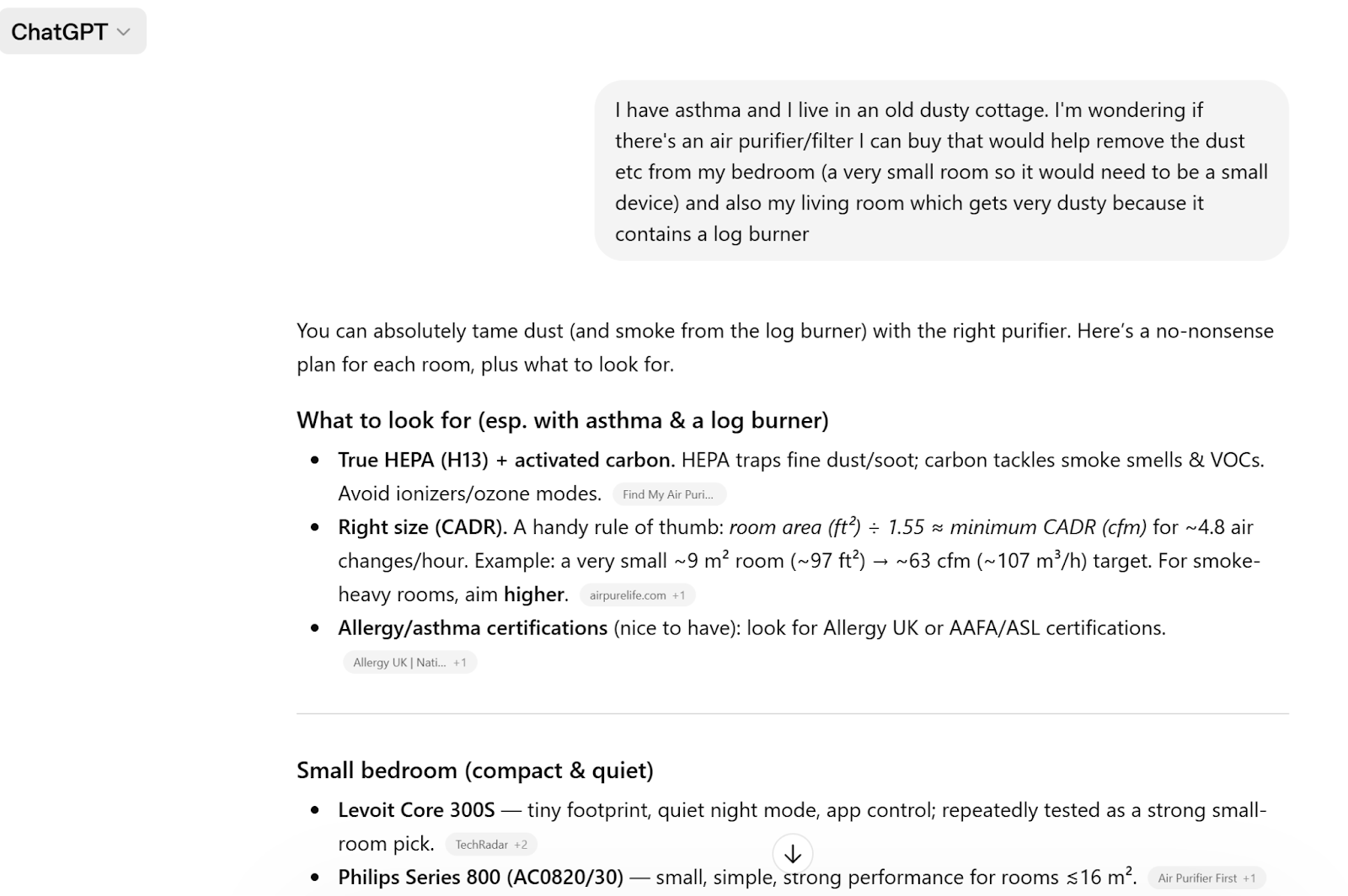
Tools like ChatGPT don't just rely on their training data. They actively retrieve current information from the web for queries where freshness matters: pricing, stock availability, recent reviews, product drops. That retrieval hits your pages much like a crawler would. If your key product information lives behind JavaScript that needs to execute before it renders, it's invisible to that fetch.
The AI can't include what it can't see.
Not every page needs to render server-side though. That's not a realistic expectation for a large ecommerce site. But the key components of your product pages should be. As Katelyn puts it:

“You can do all kinds of amazing content optimisation, structured data, everything you need—you can have this fully functioning conversion machine. But if none of that is visible, what's it all for?”
The practical check is comparing what a rendered crawl sees vs what a non-rendered crawl sees. When you turn on JavaScript crawling in Sitebulb, you can directly compare what's visible with and without JavaScript execution. Any content that appears in the rendered crawl but not the non-rendered one is invisible to bots that don't run JavaScript.
If that comparison reveals that your product names, descriptions, or prices are only appearing in the rendered version, that's the thing to fix before anything else.
What an AI discovery test backlog looks like
Search Pilot's whole model is built on measuring rather than guessing and Will is upfront that what works today may not work in six months. BUT he does share some things they’re currently testing:
Reformatting product specs into key features content
Adding more authoritative introductory paragraphs to PLPs
Buying guide Q&A
Freshness signals (more on that in a moment)
Structured data and schema
The freshness point is the one Will elaborates most. LLMs go out to the web specifically for information their training data doesn't have: current pricing, stock status, latest reviews, recent product drops. Showing that your content is fresh in those ways, and having that information highlighted on the page, is one of the things he'd prioritise testing.
Worth noting that there was a question submitted in the attendee Q&A asking whether optimisations that help LLM traffic hurt regular search traffic, or vice versa. Will’s honest answer was that the best examples are still under NDA. He can't share the specifics yet, but confirms they're real, and that case studies are coming… Watch this space!
The collaboration problem that needs your attention
Entity building is a cross-team problem.
The paid team manages the Google Merchant Center feeds and PLAs. The merchandising team populates the PIM. The product data team decides which attributes get filled in and which get skipped. All of these touchpoints contribute to how a product entity is understood by AI systems, and if they're inconsistent with each other, the entity is inconsistent.
And by the way, this is exactly the kind of situation in which soft skills development – the kind that Petra Kis-Herczegh focuses on in our enterprise SEO training course – becomes central to SEO success.
Katelyn's practical approach is to start with the workflows that already exist. If you have a working relationship with the paid team, that's where you start: getting into the GMC feed process upstream, making sure every attribute is complete, and ensuring the structured data on-site matches what's in the feed.
Structured data, she says, is "my new power word" for this year (I don’t think she’s the only one), in the same way that server-side rendering was her priority last year. It's the place where SEO and paid overlap, and it's probably the easiest collaboration to pursue.
The harder thing is teams where there isn't already a working relationship. The merchandising team entering data into the PIM probably doesn't think about SEO at all, let alone AI search. Getting their attention requires a translation step.
“That’s probably one of the biggest challenges…Getting out of your AEO, GEO, SEO lingo and figuring out how to connect with other teams. I can talk about building an entity, I can talk about products over pages. What does that mean to a merchandising team? Maybe not a lot.”
Katelyn's approach is to take people to ChatGPT or Claude, search for one of their products, and show them what the AI knows (or doesn't know) about it.
The AI panic currently consuming every boardroom in retail is, perversely, quite useful here. Everyone is looking for answers, which means everyone is open to the conversation in a way they might not have been two years ago.
As an ecommerce SEO, you're not just optimising pages anymore. You're the person who understands how the entire organisation's data infrastructure presents itself to AI systems, and you're the connective tissue between teams that have never had much reason to talk to each other.
So that drum I’ve been banging about SEOs understanding the importance of effective communication with stakeholders, cross-departmental collaboration, all that soft stuff? That’s where the opportunity lies.
What is the website's job now and in the near future?
This was the liveliest part of the webinar, and each speaker had a slightly different point to make.
People continue to use the PDP, agents handle checkout
Will took the stance of the PDP-loving tactile shopper. He believes that people still like the (window)shopping experience, and people still like product pages. His mental model for where agentic commerce actually lands in the near future is what he calls "fancy Apple Pay": agentic research (you're using AI to build a consideration set, compare options, narrow down), then a product page to actually see the thing, then everything after that (forms, account creation, address entry, payment) becomes agentic.
Frictionless checkout, essentially.
He points to Google Checkout as a precedent: the ability to complete a purchase from the search results page, without visiting the retailer's site. It existed but people didn't use it. Retailers didn't love it either, for the obvious reason that losing the session means losing the data and the relationship.
People come to the website for trust, not product detail
Katelyn has a different take. She personally loves ChatGPT Shopping. She hates the experience of comparing products, the loyalty programme maths, the friction of multi-site research. Her view on what the website's job becomes in a world where AI handles the consideration set is that the website becomes a trust signal.
If a customer has already done their research in an AI platform and clicked through to your site to verify, you're not guiding them through a purchase journey anymore. You're being evaluated in a few seconds. Fast site? Looks credible? Product information coherent and complete? The fundamentals of a trustworthy ecommerce experience matter more, not less, when the opportunity to make an impression is that narrow.
But can we trust agents to handle transactions?
Sitebulb’s Patrick, our webinar host, notes that, in a genuinely agentic transaction, where the AI is completing the purchase on your behalf, the trust requirement spreads to the platform as well as the website. You'd need to trust that ChatGPT is making the right call, not just that the retailer's site looks credible.
Trust in AI as a transaction layer is moving slowly though. Both ChatGPT and Google Shopping have scaled back their in-platform purchase integrations. Katelyn recalls confidence in AI bot checkout sitting at under 50%, though she flags that as approximate rather than a hard stat.
Either way, the rollbacks are the clearest evidence: people aren't ready to hand the transaction over yet. Trust takes time to build.
Will's view on who wins and who doesn't in an agentically-influenced future lands on what he calls a barbell distribution. The large, well-differentiated retailers have the brand recognition, the infrastructure, and the data, so they're reasonably well-placed to do well. There’s also a place for the indie at the other end of the market, where you're selling something genuinely niche and human-scale.
The riskiest place to be is the undifferentiated middle: too big to be artisan, not big enough to have built out agentic checkout. Selling products that aren't meaningfully differentiated from what's available elsewhere. Competing mainly on price or convenience against retailers with vastly more infrastructure.
There's also a point here about what AI models actually know about products. An LLM hasn't worn those running shoes. It hasn't tested that umbrella in the rain. It's basing its reasoning entirely on what other people have said and written. So proprietary product content, real reviews, your own testing notes, unique product data that exists nowhere else, is more valuable than it's ever been.
What to report when traffic isn't the metric anymore
Neither Will nor Katelyn has a fully solved answer here, and they're both honest about it.
Traffic has been eroding as a metric since AI overviews started eating informational queries. That trend isn't reversing. So if you haven't already started the conversation with your leadership team about what replaces it as a success metric, you're going to be having a much harder version of that conversation in a year.
“Traffic is an eroding metric. I think it kind of has been since AI overviews. Just let people know things are changing.”
The metrics Katelyn is beginning to track are citation rate and share of citation: how often is the brand appearing in AI-generated responses, and is the information being presented accurate?
The accuracy piece is underrated. It's one thing to get a mention, but what about if the AI confidently states the wrong price, describes a discontinued product, or gets your returns policy wrong?
Because you know AI is definitely going to get something wrong.
Meanwhile, revenue, margin, and customer acquisition cost aren't going anywhere. Those are still the ultimate business goals. The question is what leading indicators connect meaningfully to them now?
Will's answer is characteristically testing-based: for running experiments, traffic is still the right unit because statistical significance requires volume, and conversions are too noisy. Too many other factors (promotions, competitor pricing, the economy) affect them to isolate the impact of a specific page change. So Search Pilot measures in clicks, converts to revenue for business reporting, and runs LLM traffic and regular search traffic experiments separately where possible.
His broader point though is that a 2026 click isn't the same as a 2023 click. People arriving from AI-assisted search have likely done significantly more research before they get there. They're further along in their decision-making. They have more context. In that world, you could plausibly get fewer clicks and more conversions simultaneously. Tracking only clicks would make that look like failure when it isn't.
TL;DR key takeaways
💡 Regular search is still your biggest channel. Don't abandon traditional SEO in favour of GEO. That would be “a travesty”.
💡 AI systems reason over product entities, not individual URLs. Entity optimisation means building a complete, consistent, trustworthy representation of a product across every data touchpoint: structured data, feeds, PIM, on-page content.
💡 Before anything else: check that your content is visible to AI bots. JavaScript-rendered content that isn't available server-side is invisible to real-time web fetching tools like ChatGPT.
💡 The most promising AI discovery experiments right now: converting specs into key features content, authoritative PLP intros, buying guide Q&A, freshness signals on product pages, and structured markup testing.
💡 Entity optimisation is a cross-team problem. SEO can't solve it alone, so start building the relationships that don't exist yet.
💡 The website's job is shifting from journey-builder to trust signal. In an AI-researched consideration set, you may have seconds to demonstrate credibility. The basics (speed, clarity, complete product information) matter more, not less.

Jojo is Marketing Manager at Sitebulb. She has 15 years' experience in content and SEO, with 10 of those agency-side. Jojo works closely with the SEO community, collaborating on webinars, articles, and training content that helps to upskill SEOs.
When Jojo isn’t wrestling with content, you can find her trudging through fields with her King Charles Cavalier.


Related Articles
 JavaScript SEO in the Age of AI: Will Kennard Answers Your Questions

 Your AI Assistant Is Biased: Why & How To Write Prompts Mindfully


 The Agentic Web: Future of Ecommerce in the AI Era
 Sitebulb Desktop
Find, fix and communicate technical issues with easy visuals, in-depth insights, & prioritized recommendations across 300+ SEO issues.
- Ideal for SEO professionals, consultants & marketing agencies.
 Sitebulb Cloud
Get all the capability of Sitebulb Desktop, accessible via your web browser. Crawl at scale without project, crawl credit, or machine limits.
- Perfect for collaboration, remote teams & extreme scale.