




Organic Social Visibility & Multimodal Search: How to Get Cited in LLMs
 Katarina Lujak
Published March 3, 2026
This week, we're grateful to Katarina Lujak who shares original research on how social platforms are dominating SERP features, with data-driven tactics for optimizing Instagram and YouTube to increase organic visibility and LLM citations.
Traditional search trends show a shift in top-funnel informational content where websites are not the predominant end destination for a user anymore. With AI influencing traditional search, social media channels are being used as a simple short-answer solution, combating the attention decline with AIO in Google SERP.
Formats like video are getting cited in the AIOs, as in many other SERP features that are now snatching that traffic. In an environment where multimodal search is a new standard, an important part of organic strategy has to include obtaining new emerging features and formats.
To find out more about what is going on in organic social, I did research into Instagram's, TikTok's and YouTube's organic traffic. I analysed the traffic based on page types that we see most in the SERP and took two of the most opposite markets to compare: US and Germany. Their differences are based on user behaviour (target audience has different search habits), market size, and Google innovation (US having the latest trends).
Key findings from this research:
- Social network platforms are important like never before for SEO visibility
- Instagram and TikTok are implementing SEO best practices to capture organic traffic
- Google treats page types within platforms differently when displaying them in SERP
- Specific tactics exist to adapt to these changes and implement them in your SEO strategy
Contents:
Google, social networks and entities
A s ocial network’s performance directly influences how Google understands, trusts, and ranks the whole entity. Its performance also strengthens brand signals, influencing LLM knowledge and grounding searches.
Recent changes and updates from Google opened a door to increased entity optimisation, where every social media channel is treated as a separate entity.
The timeline:
July 2025: Instagram post and reels indexation began
December 8, 2025: Google announced social channel integration in Search Console
December 12, 2025: Google released the December BCAU - social media networks rise in traffic (YouTube, Instagram, TikTok)
Social platforms continued expanding their presence in rankings, AI Overviews, AI Mode, and SERP features
Social media platforms and SEO best practices
Technical SEO best practices
Instagram apparently tries to adhere to SEO best practices by implementing some critical SEO elements. I've analysed programmatic pages from the /popular/ directory that saw insane growth to 15M with the last update.
What Instagram implements:
Crawling allowed in robots.txt: no explicit rules for /popular/ (programmatic pages)
Sitemaps available in the robots.txt but not accessible to mortals
Heading logic: H1 and H2 contain keywords related to the page target keyword that appears in the URL
Meta description and page title present
Self-canonical present
Schema present: dynamically loaded with JavaScript; articles, forums present. Schema validator doesn't pick up on it, so the question stands: what is the impact?
Structured data picked by Rich Results Testing tool for one of the /popular/ URLs
Traffic and SERP features trends
The December core update helped Instagram reach new traffic heights, pushing it to 6B globally. Even though all social network platforms saw a traffic increase, some page types performed better than others.
The example below shows a jump to more than 15M organic visits for Instagram's /popular/ directory. Landing pages are made with a programmatic approach, targeting predominantly the most recent trends, names, celebrities, memes etc. Parallel to TikTok's /discover/, it is believed that reels end up under /popular/ based on having high engagement signals.
Semrush screenshot showing traffic increase to /popular/ directory
SERP features also saw development through 2025. Rolling out AI overviews meant a lot of traffic decline for many Instagram accounts (but that is another article). Below is outlined the difference between two most different markets: US and Germany.
The US saw a noticeable increase of "video carousel" with the December '25 update, while in Germany, "People Also Ask" feature got a strong presence. Both indicate a super informational intent where US SERP is noticeably more visual than German.
SERP features growth for 2025 US; noticeable growth of “video carousel”

SERP features growth for 2025 Germany; noticeable growth of “People also ask”
Where indexable URLs rank: Germany vs US
My research shows where the popular page types rank in SERP and how Google understands them. Numbers show years data with the snippet taken in January 2026.
Page type | Top SERP features (US) | Top SERP features (DE) | What users want | Google interpretation | Relevance for SEO strategy |
|---|---|---|---|---|---|
/popular/ | Image pack (40,863) Knowledgepanel (1,750) Video carousel(1,374) | Image pack (4,591) Knowledgepanel (491) Video carousel(292) | Confirmation, context, recognition, inspiration Evaluation before buying Social proof | "This shows what it looks like" Context and social proof | Shaping trends with ambassadors and influencers working on their visibility, subsequently helping the brand. |
/reels/ | People also ask (11,015) Image pack (6,201) Knowledge panel (2,301) AIO (1,580) | Image pack(898) Knowledge panel(517) People also ask(175) AIO(44) | Explanation and quick understanding Short answers How-tos | "This helps explain" Explain, illustrate, contextualise | A reel can be targeted as non-brand for semantic clarity but also for engagement. |
/p/ | Image pack (3,321M) People also ask (1,623M) Top stories (571,870) AIO (332,574) | Image pack (212,637) People also ask (112,083) Top stories (38,613) AIO (20,341) | Tracking moments as they happen Brand drops, campaigns, collaborations Proof of buzz and social validation | "This just happened" Contextual references | - Launches - Campaigns -Collaboration - Product drops |
YouTube
Technical SEO best practices
YouTube follows best practices in terms of having detailed robots.txt and accessible sitemaps included.
Traffic and SERP features trends
YouTube, as Google's owned network, has seen a sharp increase in traffic since May 2025, totalling 18B globally after the December update. Below is an example of the YouTube shorts format, which saw a drastic increase.
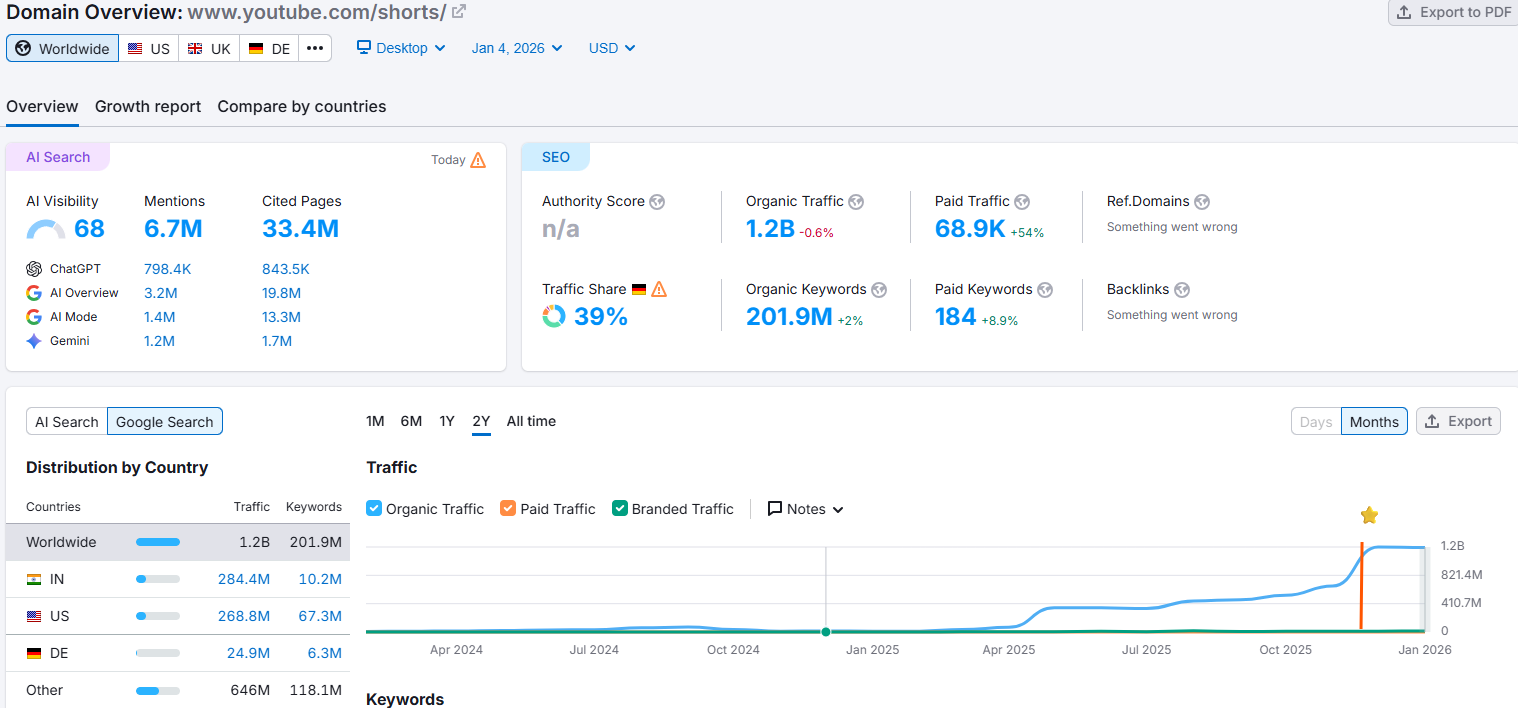
Youtube /shorts/ traffic increase with the last core update in December ‘25
SERP features have been developing throughout the year as well, with "video carousel" being the predominant feature that increased its presence for YouTube videos in both Germany and US. The mix for both countries includes "People Also Ask" and AIO rising for both countries, while more noticeable in the US. As mentioned for Instagram, US search is evidently more visual.

SERP features growth for 2025 US; noticeable growth of “video carousel”

SERP features growth for 2025 Germany; considerably less AIO in total results
Where indexable URLs rank in US and Germany
My research shows where the popular page types rank in SERP and how Google understands them.Numbers show years data with the snippet taken in January 2026.
Platform page type | Top SERP features (US) | Top SERP features (DE) | What users want | Google interpretation | Comment |
|---|---|---|---|---|---|
/watch/ Strong growth post-Dec update of Video carousel | Video (793M) Video carousel (135.4M) People also ask (33.8M) | Video carousel (12.6M) People also ask (2.6M) Image pack (1.8M) AI Overview (859.3K) | People come to watch, learn, and understand first | Google decomposes queries into entities, modifiers, and context. The goal is to clearly solve the query with the best long-form video surface. | Watch content is treated as authoritative visual reference material. Strong alignment with AI Overviews and PAA reinforces explanatory value. |
/shorts/ | Video carousel (7.3M) People also ask (3.4M) AI Overview (1.3M) | Video carousel (481K) People also ask (212.6K) AI Overview (58.6K) | Learn a fact quickly See a short explanation Get a visual snippet | This is not "how to". It's "oh, interesting". Google removes friction from curiosity and lightweight discovery. | It can be brand highlights, user reshares, teasers, ambassador content… |
/playlist/ | No features for the directory | No features for the directory | With traffic in decline for this directory, optimizing for SERP features is not worth the effort | This is where: - Brands can educate (not interrupt) - Expertise compounds over time - Trust beats reach | Directory declines in traffic but provides a great opportunity for brands to bundle "how-tos", "buyer guides" and reviews from third-party creators onto owned channel. |
TikTok
TikTok also tries to adhere to SEO best practices, implementing critical SEO elements and overdoing it in the process. Unlike Instagram, people at TikTok have implemented some strong signals to tell Google how they want pages to be read.
Technical SEO best practices
What TikTok implements:
Crawling allowed in robots.txt for /discover
Heading logic: follows default H1 and H2 page summary
Page summary mimics listing page description. It’s made with AI so it's always with a last date timestamp.
Meta description and page title present
Canonical tag present
Robot meta tags: index, follow for /discover/ pages
Schema: dynamically loaded with JavaScript; articles, forums present. Unlike Instagram's structured data, Schema Validator picks up breadcrumbs data.
Schema Page type: CollectionPage found which is typical for listing pages https://www.tiktok.com/discover/how-to-do-sitemap-for-website
No sitemaps in robots.txt
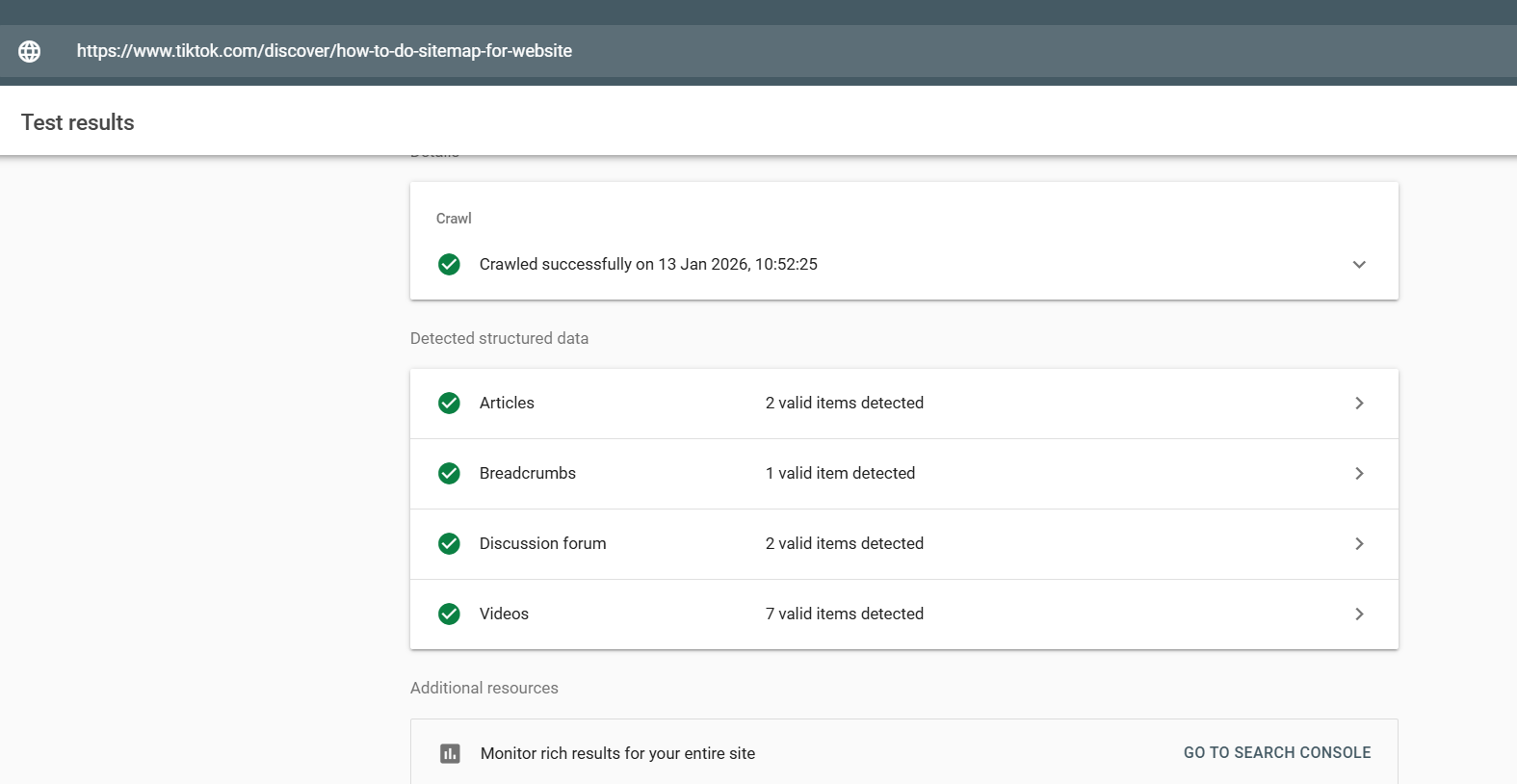
Structured data detected by Rich data testing tool for a programmatic page typ e
Traffic and SERP features trends
The Discover directory has been far less successful than Instagram Explore /popular/. Traffic has been declining since the 2024 June spam update.
There are several reasons for this, mainly because this arm of TikTok has been used as a spam vehicle and for parasite SEO practices. Think in terms of content websites from 10 years ago ranking for "how big is a sperm whale". There's also the political background of ownership and debate in US media, so overall it isn't surprising. The latter we cannot prove; however, the data is clear.
Organic traffic decline for /discover/ directory shown in Semrush
The majority of organic traffic goes to account profiles. There is less variation by page type in top pages that have high traffic (US). Unlike Instagram's /p/ and /reels/ and YouTube's /watch/ and /shorts/, TikTok's /video/ and /discover/ are not equally represented. This is why my later suggestion is not to use TikTok as a visibility vehicle but rather to grow the brand signals within the network.
How to include this in an SEO strategy
Google changed, and so should your SEO strategy. I'm not advocating for spamming of any kind here but for logical use of the resources available.
People want to see human experience first, and obviously the attention span allocated has decreased. Not to be judgemental, but the technology has changed, and we just don't need as many words as before.
I'm working with the assumption that once the brand gets higher visibility in the SERP features, it will be more likely for the LLMs to pick up on the brand signals. The good people at Ahrefs have done a study that shows that “brands which are mentioned more on YouTube, are more likely to show up across ChatGPT, AI Overviews, AI mode.”
What I advise
Make sure structured data implemented on your website follows best practices and is readable to bots
Make YouTube profile part of Web Source
Use TikTok to grow engagement and brand signals
Try not to interfere with the authenticity of Reddit if the brand is being spoken about
Optimisation focus
Based on the data, target networks to work with:
YouTube
Instagram
Potential tactics: Instagram
Increase the number of non-brand reels and posts in the content creation, considering what Google wants to see based on page type
Optimise reels and posts based on the research data: align with brand calendar for launch campaigns, align with content calendar for semantic targeting
Focus on keywords, not hashtags
Make an SEO template guideline for reels/posts
Potential tactics: YouTube
Optimise playlists for logical intent: these can be how-tos and guides
Videos for some niches can be repurposed for Instagram or TikTok
Create playlists on the owned channel with reviews by other people (if products involved)
Increase the number of product reviews and ambassadors per selected market
Website integration
Integrate Instagram posts as social proof on the website: this can be an element that sources content from Instagram based on hashtags
Integrate YouTube review playlists in users' journey: this can be for example a listing page with comparison videos
Include YouTube videos and shorts in blogs
KPIs to track
Increased visibility from SERP features where domain ranks (brand and non-brand): Video carousel, People also ask, Featured Video
Increased number of indexed reels and posts
This Wordlift workflow is great. Use it to analyse Instagram content alignment with your website and organic search rankings.
Now go and talk to your social team!
Sitebulb TL;DR
💡 Social platforms (Instagram, YouTube) are now critical SEO channels - their performance directly influences how Google understands and ranks your brand entity
💡 Instagram's /popular/ directory grew to 15M visits after December 2025 update, while YouTube reached 18B globally - both platforms are implementing SEO best practices to capture organic traffic
💡 Google treats page types differently: Instagram /reels/ appear in "People Also Ask", YouTube /watch/ dominates "Video carousel", showing clear intent patterns between markets (US more visual, Germany more text-based)
💡 Optimise YouTube playlists for "how-to" intent and Instagram reels for keywords (not hashtags) - integrate both into your website as social proof and contextual references
💡 Track SERP feature visibility (video carousels, People Also Ask) and indexed social content as KPIs - higher visibility in these features increases likelihood of LLM citations

Sitebulb is a proud partner of Women in Tech SEO! This author is part of the WTS community. Discover all our Women in Tech SEO articles.

Katarina is an SEO strategist who’s spent her career helping publishers and global brands win in organic search. She works at the intersection of content, technical SEO, and strategy, with a strong focus on sustainable, long-term growth. She believes the best SEO happens early—spotting patterns before they scale and turning them into formats users love and bots clearly understand.

Related Articles
 Your Products Are Entities Now. And AI Can Only Work With The Data You Give It.

 JavaScript SEO in the Age of AI: Will Kennard Answers Your Questions
 Your AI Assistant Is Biased: Why & How To Write Prompts Mindfully

 Sitebulb Desktop
Find, fix and communicate technical issues with easy visuals, in-depth insights, & prioritized recommendations across 300+ SEO issues.
- Ideal for SEO professionals, consultants & marketing agencies.
 Sitebulb Cloud
Get all the capability of Sitebulb Desktop, accessible via your web browser. Crawl at scale without project, crawl credit, or machine limits.
- Perfect for collaboration, remote teams & extreme scale.