




 Aimee Jurenka
Massive thanks to Aimee Jurenka who talks us through how to handle informational content in the age of AI summarization, with a handy optimization checklist.
Remember when writing a “helpful” article was enough?
You’d answer a question, publish a blog post, maybe optimize a header or two, and call it a win. Users clicked. Content did its job.
Not anymore.
In 2026, informational content doesn’t have the luxury of being needed. AI search systems now extract, summarize, and recombine answers before users ever see a page. If your content doesn’t add something distinctive, credible, or brand-specific, it’s often skipped entirely.
This isn’t a dip in traffic. It’s obsolete.
So let’s talk about what’s actually changed, why so much informational content is quietly being made redundant, and, most importantly, how to redesign informational content so it still earns a role in AI-driven search experiences.
Contents:
Why Informational Content Is Becoming Obsolete
For years, informational content existed to answer questions.
If someone wanted to understand a topic, compare options, or learn how something worked, they had to visit a website. Content was the delivery mechanism.
That assumption is gone.
In March 2025, over 27% of U.S. Google searches ended without any click to an external website—up from 24.4% the previous year. Of every 1,000 searches, only 360 result in clicks to the open web (Search Engine Land, 2025). Search systems decide which information is credible, compress it into summaries, and resolve queries upstream.
As a result, huge volumes of traditional informational content are becoming obsolete. Not because they’re wrong but because they’re unnecessary.
If an AI system can confidently generate the answer without relying on your content, your content no longer serves a function in the journey.
Most informational content was never designed for this delivery model. It was written to be read top-to-bottom, not extracted, compared, and reused.
Stop Writing for Keywords. Start Writing for Association.
We’ll get this out of the way early.
Keyword-first informational content doesn’t work the way it used to.
That doesn’t mean keywords are dead. It means they no longer determine what your brand is known for.
Before writing anything, brands now need to answer a different question:
What do we want AI to associate with us?
That’s where topic entities come in.
Instead of starting with “What keyword should we target?”, start with:
What problems should we be associated with?
What expertise should we be known for?
What concepts should consistently appear alongside our brand?
Keywords help systems find you.
Entities help systems understand you.
If you don’t define those associations intentionally, AI will form them on its own inconsistently, or worse, incorrectly.
Originality Means Information Gain
Skyscraper content had its moment.
But re-explaining what already exists even more clearly & then adding one new thing isn’t enough in AI search.
Why?
Because AI systems compare content against existing indexed material to determine whether it provides genuinely new insights, clarifies complex ideas, or offers practical applications that are missing elsewhere. As Google advises, focus on making “unique, non-commodity content” that adds real value (Google Search Central, 2025).
That’s where information gain comes in—what does this add that isn’t already obvious?
Before publishing any informational content, ask:
What does this add that isn’t already obvious?
What misconception does it clear up?
What decision does it actually help someone make?
Longer isn’t better.
Clearer is.
Generic Content Is AI’s Job. Yours Is Specificity.
This is the uncomfortable part.
AI can generate generalized informational content all day long.
That is literally what it’s designed to do.
What it can’t invent is your proprietary context.
This is where informational content needs to become brand-specific.
That includes:
Buyer-persona-specific problems & constraints
How your product or service actually solves those problems
Real features, limitations, and tradeoffs
Stats, benchmarks, or outcomes only you can provide
If you don’t publish this information, AI will still answer the question, just without you.
This isn’t promotional content.
It’s source material.
AI needs trusted inputs to generate accurate outputs. Brand-specific informational content gives it something concrete to work with.
Specificity signals confidence.
Confidence signals reliability.
Reliability is what gets reused in AI answers.
Authorship, Brand, and Trust Signals
Anonymous informational content is increasingly invisible.
Google’s quality evaluation guidelines emphasize Experience, Expertise, Authoritativeness, and Trustworthiness (E-E-A-T), with particular focus on who created the content and why they’re qualified. According to these guidelines, trust is the foundational element—without it, even expert content struggles to gain visibility (Google Search Central, 2025;Search Engine Journal, 2024).
Search systems now care deeply about:
Who wrote this?
Why are they qualified?
Why should this brand be trusted on this topic?
That means:
Clear authorship
Consistent bylines
Visible digital footprints
Cohesive brand positioning across content
Authorship isn’t decoration.
It’s part of how credibility is evaluated.
Editor’s Note: You might also like 5 Steps to Enhance E-E-A-T for Better SEO Rankings by Jason Hennessey
Track Signals, Not Just Sessions
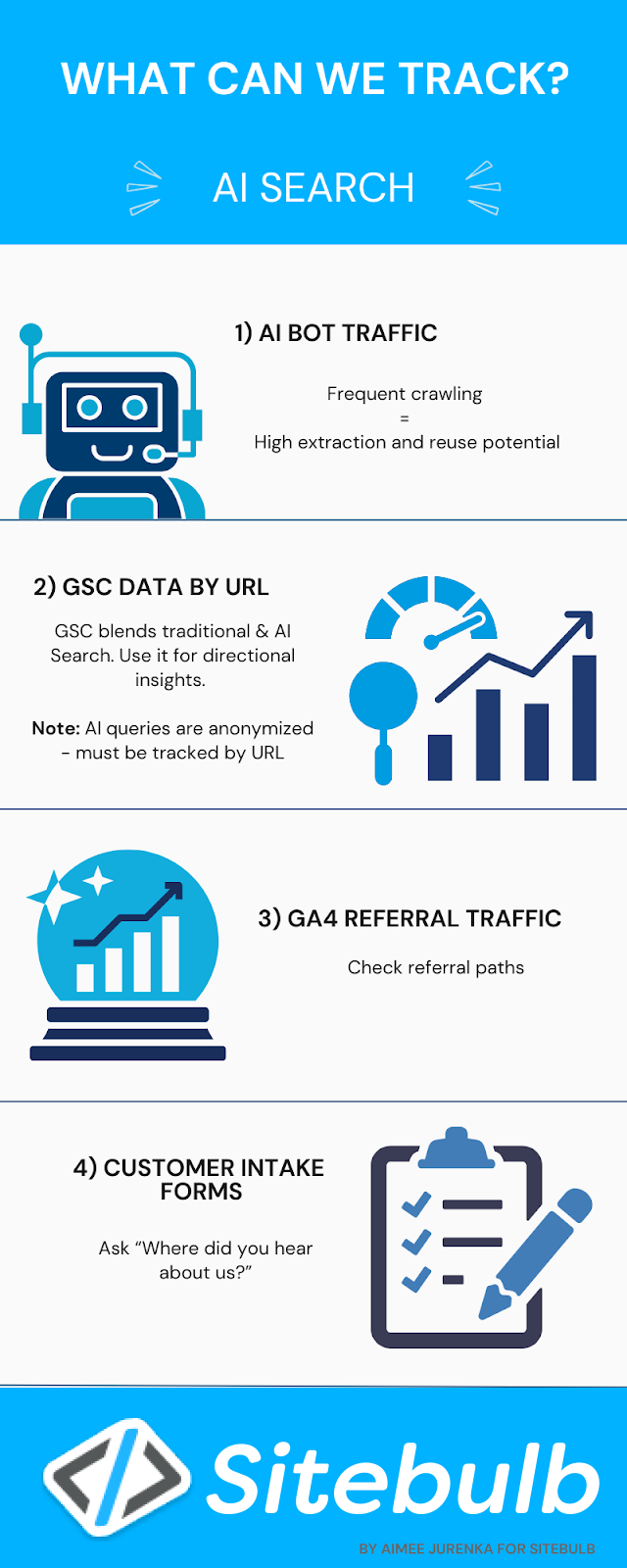
AI-influenced content won’t always generate trackable sessions, but it will influence decisions. Here's what to monitor instead:
AI bot crawl frequency: frequent crawling = high extraction potential
Here’s a list of all the bots you want to look for
GSC data (by URL) it’s blended with trad search, so they’re directional, not definitive
We just found out the queries are anonymized, so you have to track by URL
GA4 referral traffic
Here’s a how-to-vid from Dana DiTomaso
Customer intake forms
Tried and true way to get attribution info
AI visibility doesn’t always leave a footprint in your analytics. But it leaves a mark in the mind of your audience. Track the signals that shape perception even if they don’t show up as sessions.
To Summarize
Informational content isn’t dead.
But the version that existed to “answer a question and earn a click” is quietly being phased out.
The future of informational content is about:
Attribution, not just answers
Brand context, not generic advice
Being the source AI trusts not the page that ranks
We don’t need to outsmart AI.
We need to give it something worth repeating.
Informational Content: Then vs Now (AI Search Era)
Dimension | Traditional Inbound Content | AI-Ready Informational Content |
|---|---|---|
Primary Goal | Rank for keywords | Be selected & attributed |
Unit of Value | Webpage | Grounding chunk (passage) |
Ideal Length | Long, comprehensive | As short as needed, as clear as possible |
Structure | Linear, narrative | Modular, self-contained sections |
Topic Selection | Keyword volume & difficulty | Topic entities & brand association |
Originality | “Skyscraper” improvements | Information gain & clarity |
Answer Placement | Explained, then answered | Answered immediately |
Context Dependency | High | Minimal |
Reuse by AI | Risky | Safe & extractable |
Trust Signals | Implicit | Explicit (author, expertise, brand) |
Success Metric | Rankings & CTR | Selection, attribution, reuse |
Checklist: How to Make Informational Content AI-Ready
Use this as a practical gut-check before publishing or updating any informational content.
1. Define the Association First
Can you clearly state what you want AI to associate this content with?
Is the topic tied to a specific product, service, or area of expertise?
Would an AI system understand why your brand is relevant here?
If the association is fuzzy, the content will be too.
2. Anchor Content to a Topic Entity
Is this piece part of a larger topic cluster?
Does it reinforce a core concept rather than introduce a one-off idea?
Are terminology and definitions consistent across related pages?
Isolated posts are forgettable. Cohesive topics aren’t.
3. Check for Information Gain
Does this add something new or just restate what already exists?
Does it clarify a misconception or edge case?
Does it help someone make a decision, not just understand a term?
If you removed this page, would anything actually be lost?
4. Eliminate Generic Advice
Could AI generate this content without knowing your brand?
Are buyer-persona problems and constraints explicitly named?
Does the content include brand-specific features, stats, or context?
If it sounds like it could belong to anyone, it belongs to no one.
5. Make Sections Extractable
Does each section stand on its own?
Are answers clear before explanations?
Could a paragraph be quoted without additional context?
AI doesn’t read in order. Design accordingly.
6. Surface Trust Signals
Is the author clearly identified?
Are credentials, experience, or firsthand involvement visible?
Does the brand’s authority come through naturally?
Trust is demonstrated.
7. Optimize for Engagement, Not Just Clicks
Is the content scannable and easy to summarize?
Are there clear subheadings and logical flow?
Would a user (or AI) understand the key takeaway in under 10 seconds?
Clarity beats cleverness every time.
Final Gut Check
Ask one last question:
If an AI had to explain this topic tomorrow, would it need my content, or would it ignore it?
If the answer is “ignore,” you’ve got work to do.
Sitebulb TL;DR
💡 Traditional informational content designed to "answer and earn a click" is becoming obsolete, as AI search systems extract and summarize answers before users see your page
💡 Stop writing for keywords alone! Focus on what you want AI to associate with your brand through topic entities, not just keyword rankings
💡 Information gain matters more than comprehensiveness. AI systems compare content to determine if it adds genuinely new insights, not just longer explanations
💡 Generic advice is AI's job; your job is brand-specific context including proprietary stats, real features, constraints, and outcomes only you can provide
💡 Authorship and trust signals (clear bylines, credentials, expertise) are now essential for credibility evaluation by AI systems, not optional decoration

Sitebulb is a proud partner of Women in Tech SEO! This author is part of the WTS community. Discover all our Women in Tech SEO articles.

Aimee Jurenka is an SEO & AI Visibility Strategist at RicketyRoo and the founder of seo SUSTAINABLE. With over a decade of experience across technical SEO, content strategy, and on-page optimization, she helps brands evolve from traditional 10-blue-link thinking into an AI-first era of search.

Related Articles
 JavaScript SEO in the Age of AI: Will Kennard Answers Your Questions

 Your AI Assistant Is Biased: Why & How To Write Prompts Mindfully

 The Agentic Web: Future of Ecommerce in the AI Era
 Sitebulb Desktop
Find, fix and communicate technical issues with easy visuals, in-depth insights, & prioritized recommendations across 300+ SEO issues.
- Ideal for SEO professionals, consultants & marketing agencies.
 Sitebulb Cloud
Get all the capability of Sitebulb Desktop, accessible via your web browser. Crawl at scale without project, crawl credit, or machine limits.
- Perfect for collaboration, remote teams & extreme scale.