

Why Technical SEO Audits Fail Ecommerce Teams (and How to Fix That)
 Anna Moragli
Published May 28, 2026
Anna Moragli is here to walk us through maximizing ecommerce SEO success with a tried and tested prioritization framework.
Let’s be honest - technical SEO has long been treated as a box-ticking exercise. Just another checklist to get your site crawled and indexed by Google. But in 2026, that mindset is holding back ecommerce businesses and making them lose revenue.
In reality, technical SEO is your growth engine. It’s the invisible infrastructure that unlocks new revenue by making sure your content is actually found and valued by search engines. Ignore it, and you risk stalling your entire growth strategy.
I’ve seen it firsthand - great content and strong backlinks get lost in the shuffle because technical problems block progress.
Here’s where most ecommerce SEO strategies start to unravel:
High-value pages that never see the light of day in search results
Duplicate or near-duplicate URLs muddying your site’s authority signals
Important product or category pages are fighting against irrelevant variants, leading to keyword cannibalization
Precious crawl resources are wasted on low-value or thin pages
And the result? You get indexation issues, rankings that seem to bounce around for no reason, and unpredictable organic performance - even after you’ve poured resources into content and digital PR.
If you want your efforts to count, technical SEO is the layer that gives your site a good chance.
In this article, I’ll break down exactly how technical SEO impacts ecommerce revenue, and how to prioritize what really matters so you’re not drowning in a sea of “fixes.”
Contents:
Why most technical audits fail after delivery
Technical SEO audits are notorious for producing overwhelming lists - hundreds of “issues” that paralyze teams rather than initiate action.
We all know what happens next.
Nothing happens and nothing is planned.
Too often, technical SEO audits end up as static reports: 200+ issues, dozens of screenshots, and a sense of urgency - but little real movement. Here’s why these audits frequently fail to drive meaningful change:
1. 200+ issues ≠ strategy
A huge list of problems without any prioritization is not a plan. Even the most experienced teams struggle to decide what matters most and where to start.
2. No business context
Most audits ignore the ecommerce revenue model. Issues are presented in isolation, with no linkage to revenue pages, critical user journeys, or seasonality. This disconnect makes it hard for executives to plan the implementation.
3. No prioritization logic
All issues are treated equally, creating analysis paralysis. Teams lack a framework to assess which fixes will deliver the highest return on effort.
4. No ownership mapping
Audit recommendations often blur responsibility: is this a dev issue, a CMS setting, or a product decision? Without clear ownership, action stalls at the handoff.
The result?
Issues go unresolved, opportunities are missed, and technical debt grows - undermining organic growth.
From audit chaos to strategy: 5 quick tips
So how do we turn these audits into a revenue-driving strategy? SEOs must shift from a huge 200+ items list to a business-aligned, prioritized roadmap.
1. Synthesize, don’t list
Group issues thematically (e.g., crawlability, indexation, rendering, templates) and distill the audit into clear problem statements, not just granular errors. Summarize the “so what”- why does each cluster matter for business growth?
2. Map each issue to business value
Tie every technical finding back to revenue pages, key user flows, or measurable ecommerce KPIs. For example, highlight how a canonicalization issue on product listing pages could dilute ranking signals for your top categories, impacting sales.
3. Assign clear ownership
Explicitly designate responsibility for each action item - SEO, development, product, or content team. Build your backlog in a shared project management tool (Jira, Asana, Trello) and tag each task to its owning team. This clarity ensures nothing falls through the cracks.
4. Communicate in stakeholder language
Frame recommendations in terms of business risk, opportunity, and revenue impact. Use visuals, traffic projections, and concrete examples to secure buy-in and resources from leadership.
5. Make the audit a living document
Revisit, update, and reprioritize the technical SEO backlog as your ecommerce site evolves. Treat this as ongoing operational work rather than a one-time event. This agility ensures your technical foundation scales with business growth.
The Technical SEO Prioritization Framework
Now let’s move to the most important part of this article, which is how to actually prioritize the items in your audit to make sure you have the best possible results.
Along the years, I’ve tried multiple methods for prioritizing technical issues, so as to help the team to move faster with implementation. This is the most effective one by far:
The 4-axis evaluation model for every issue
Axis | What to ask | Why it matters |
|---|---|---|
1. Impact on Revenue Pages | Does this impact directly PDPs, PLPs, brand, or high-traffic pages? | Fixes to revenue-driving templates lead to exponential results. |
2. Indexation & Crawl Impact | How many URLs are affected by this change? A few, dozens or thousands? | Sitewide issues waste crawl budget and dilute ranking potential. |
3. Severity & Blocking Level | Is this preventing indexing or just suboptimal? | Prioritize fixes that unblock growth over marginal gains. |
4. Implementation Cost | Is this a major platform change? | Major changes need a solid business case. |
Example Applications
Issue: Suboptimal pagination discovery & depth
High priority: quick win with large-scale impact
Issue: Deep pagination sequences lacking a "View-All" button.
Impact on Revenue Pages: High-traffic Product Listing Pages (PLPs) suffer from "Page 2+ Syndrome," where products buried deep in pagination receive zero link equity and fail to rank for long-tail keywords.
Indexation & Crawl Impact: Affects thousands of URLs. Googlebot often stops crawling after the first few pages of a paginated set if the signals are weak, leading to "Discovered - currently not indexed" status for deep-cat products.
Severity: High. Causes massive crawl waste and prevents product-level indexation.
Implementation Cost: Template-level fix; moderate effort (requires updating UI components
Issue: Minor CSS render-blocking on blog pages
Low priority: schedule after higher-impact work
Impact on Revenue Pages: Not critical
Indexation & Crawl Impact: Dozens of URLs
Severity: Suboptimal performance, not blocking
Implementation Cost: Simple fix
Issue: Incorrect canonical tags on product variant pages
High priority: Protects indexation and revenue from long-tail queries
Impact on Revenue Pages: Affects all variant PDPs (e.g., size, color), risking canonicalizing away valuable URLs
Indexation & Crawl Impact: Hundreds or thousands of PDPs may not be indexed correctly
Severity: Loss of long-tail rankings for variant SKUs, cannibalization or loss of revenue
Implementation Cost: Template or platform fix, moderate effort
Issue: Broken breadcrumb markup on category pages
Medium priority: Improves UX and potential for enhanced SERP features
Impact on Revenue Pages: Affects PLPs and navigation for users and search engines
Indexation & Crawl Impact: Hundreds of URLs, can limit rich results and internal linking benefits
Severity: Suboptimal performance, but not blocking
Implementation Cost: Template-level fix, low to moderate effort
Issue: Orphaned product pages (no internal links)
High priority: Quick SEO/content win with direct revenue implications
Impact on Revenue Pages: Affects PDPs, including high-value or seasonal items
Indexation & Crawl Impact: Orphaned URLs are hard for search engines to discover and index
Severity: Products may never rank or appear in search, directly impacting potential sales
Implementation Cost: Content/SEO fix—requires internal linking strategy and process updates
Issue: Faceted navigation generating crawlable parameter URLs
High priority: Sitewide impact, essential for large-scale ecommerce sites
Impact on Revenue Pages: Impacts category pages, and potentially PDPs via duplicate/filter variants
Indexation & Crawl Impact: Can create tens of thousands of low-value or duplicate URLs, wasting crawl budget
Severity: Causes crawl budget waste, dilutes ranking signals, and risks duplicate content penalties
Implementation Cost: Requires dev work or platform configuration (robots.txt, noindex, canonical, or parameter handling)
By objectively scoring issues across these axes, you can create a roadmap that aligns technical fixes with business impact - not just technical hygiene.
Turning findings into a living technical SEO backlog
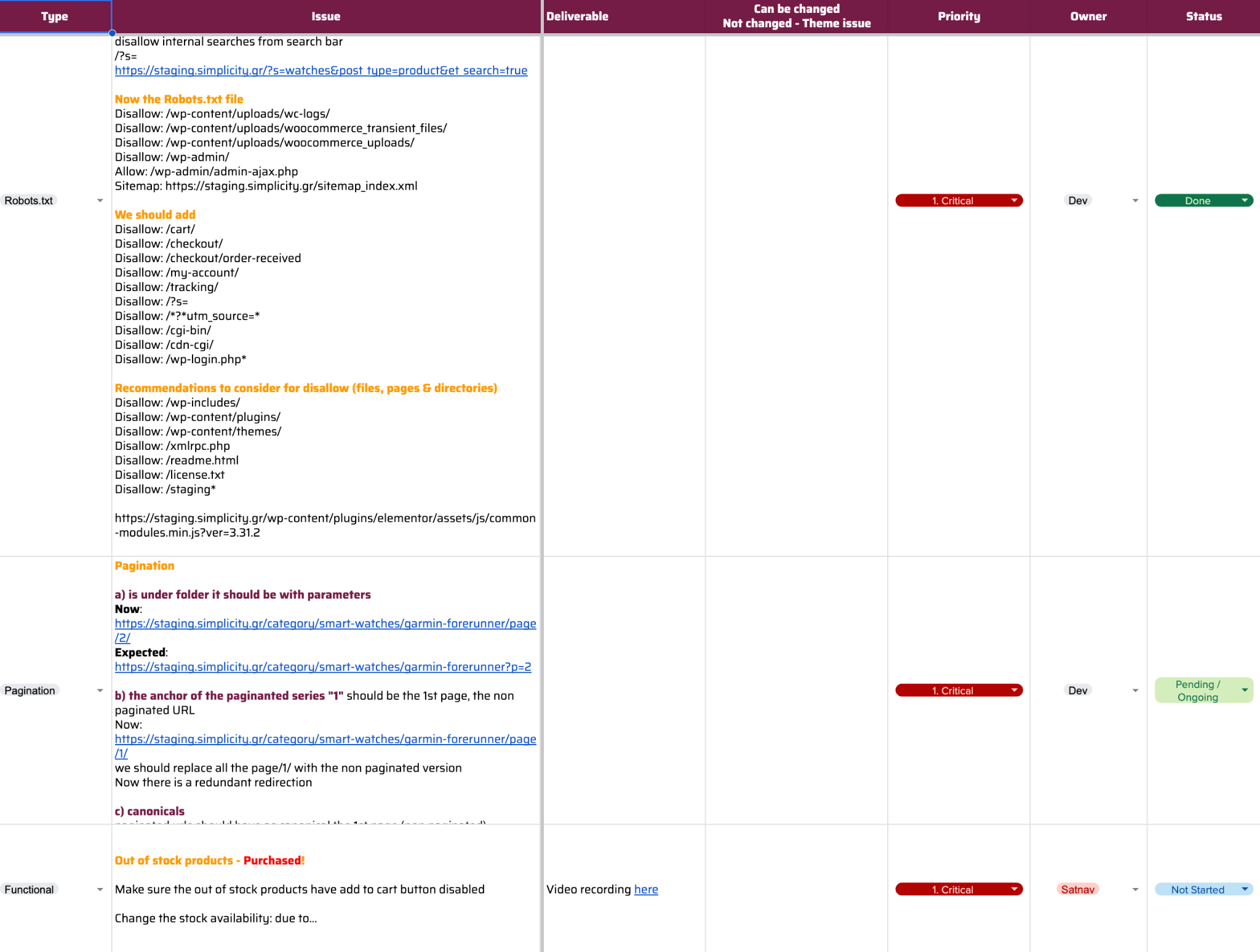
A technical SEO audit should be a living document, feeding an actionable backlog that evolves alongside your ecommerce roadmap.
At this stage you need to do the following actions.
Group issues by type:
Platform limitations: Requires vendor or major engineering involvement (e.g., rendering, routing, headless CMS constraints).
Template-level fixes: Can be handled within existing development sprints (e.g., meta tags, schema updates, pagination logic).
Content/SEO rules: Owned by SEO/content team (e.g., internal linking guidelines, canonical best practices).
Align fixes with delivery cycles:
Dev sprints: Integrate high-priority, low-complexity issues into regular sprint cycles. Use story points from your 4-axis framework to estimate effort.
Release cycles: Schedule platform-level or high-impact fixes in line with major releases or upgrades. Build business cases around revenue impact and crawl efficiency.
Pro tip: Regularly review, re-prioritize, and re-assign issues as new data emerges (site changes, algorithm updates, shifting business priorities). This exercise should be done at least every 3 months.
Real ecommerce case studies: Problems, decisions, and solutions
The proof is always in the results. Let’s look at how leading ecommerce sites turned complex technical SEO challenges into measurable wins by applying strategic frameworks - not just checklist fixes.
Case 1: Large fashion ecommerce (500k+ URLs)
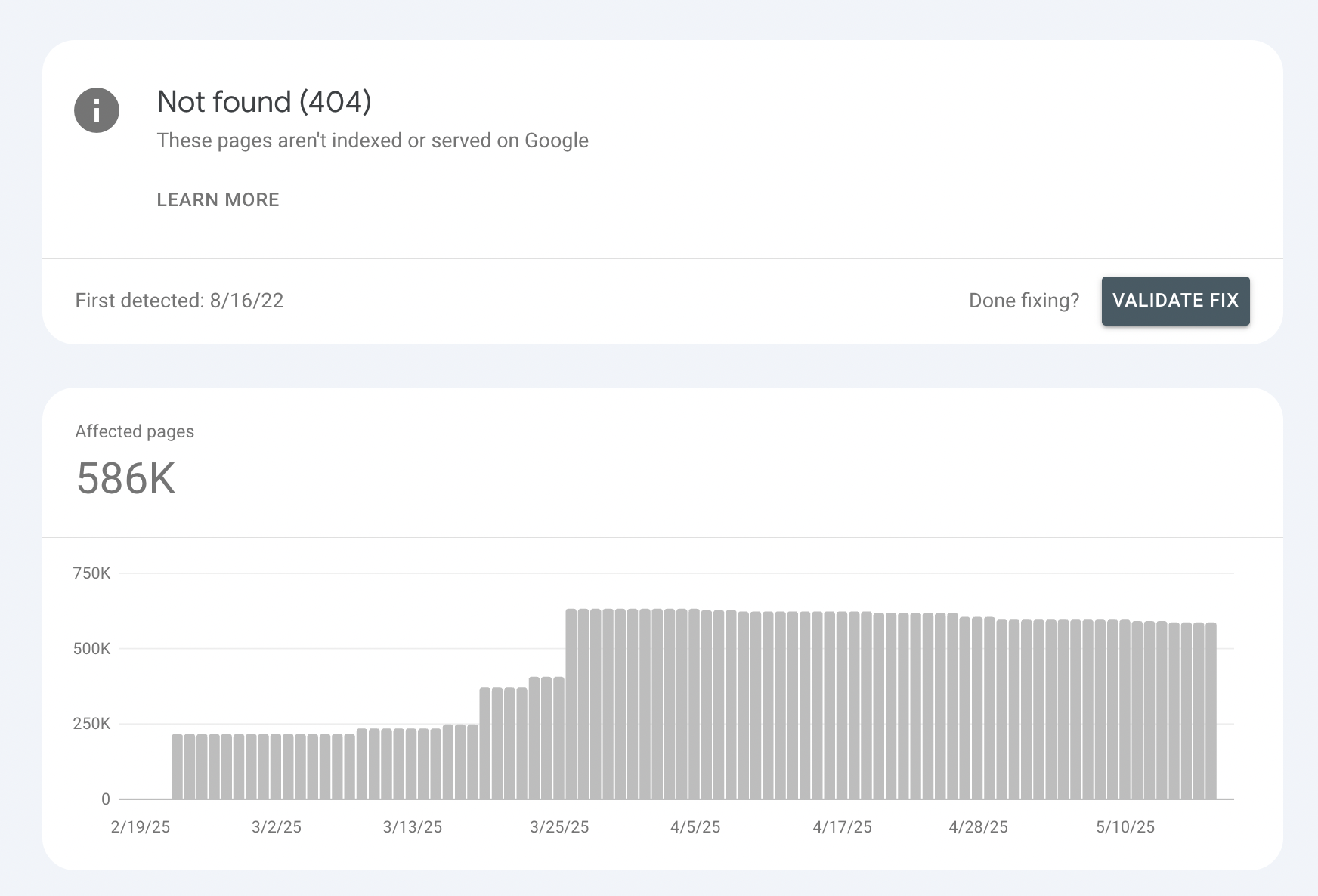
Problems
With over half a million URLs, this retailer’s crawl budget was being squandered:
80% of crawl activity hit low-value faceted URLs (e.g. /dresses?color=blue&size=12&price=under-100)
Business-critical category pages were indexed slowly or missed altogether, throttling new product launches
Decisions & Solutions
1. Facet rules based on search demand:
Conducted keyword research to identify which facet combinations were actually being searched for and driving revenue.
Created a allow list of valuable filter combinations (e.g., /dresses?color=black&size=10) and get them indexed and set all others to noindex,follow using meta tags and robots.txt rules.
2. Internal linking cleanup:
Map internal links pointing to parameterized and low-value URLs.
Updated navigation, filters, and related products modules to link only to self-canonical versions of category and product pages.
3. Sitemap cleanup & restructure:
Audited and rebuilt XML sitemaps to exclude:
404s URLs
Out of stock products
Non-essential parameterized URLs
Ensured sitemaps contained only canonical, index-worthy pages
Set up automated sitemap generation and validation to catch regressions before they hit production.
Split sitemaps to the following subsitemaps:
Category Pages sitemap
Product Pages sitemap
Brand Pages sitemap
Filter Pages sitemap
Blog Pages sitemap
Static Pages sitemap
Result
+35% faster indexation of new product lines and a significant lift in organic traffic to core categories, with no drop in long-tail traffic from high-demand facets.
Case 2: Enterprise marketplace with canonicalization issues
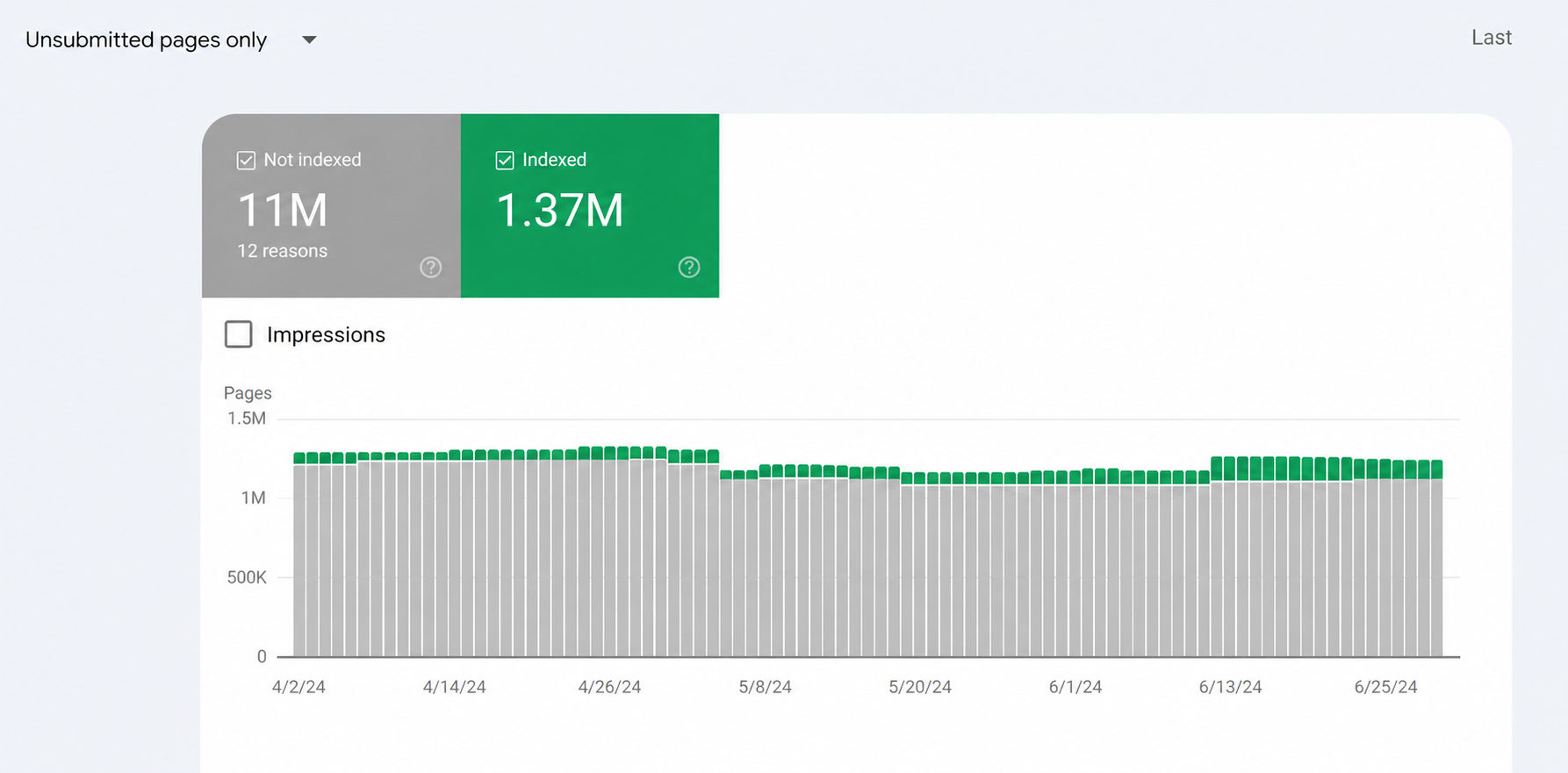
Problems
Filtered URLs (e.g., /laptops?brand=dell) lacked canonicalization, causing duplicate content
Products accessible via multiple category paths, creating inconsistent signals and diluting link equity
Sitemaps bloated with 404s, expired, and out-of-stock products, confusing search engines and wasting crawl budget
Decisions & Solutions
1. Rebuilt canonical rules based on URL intent:
Audited all product and category templates to identify where canonical tags were missing or misapplied.
Developed logic to assign canonical tags according to search intent:
For product pages, always point to the primary product URL (removing category or filter parameters).
For category/filtered pages, canonicalize to the main category unless there was proven search demand for a specific filter.
Documented canonicalization rules for all stakeholders to maintain consistency.
2. Enforced a single, stable canonical path for each product:
Worked with engineering to ensure each product could only be accessed via one clean, canonical URL, regardless of how users navigated (by brand, by category, by sale, etc.).
Put in place 301 redirects from non-canonical paths to the canonical URL.
Updated internal links and sitemaps to align with the canonical structure.
3. Clean sitemaps:
Automated sitemap generation to exclude 404s, out-of-stock, and duplicate URLs.
Scheduled regular sitemap validation and resubmission as part of release cycles.
Integrated sitemap management into the deployment pipeline to catch errors before they reached search engines.
Result
Google’s indexation of duplicate and irrelevant URLs dropped by over 70%. Product pages saw a 153% quarterly increase in organic revenue, and crawl errors in GSC decreased dramatically. The site achieved more stable rankings and improved visibility for its highest-converting products.
Technical SEO for ecommerce is a strategic advantage
Every ecommerce website, from smaller brands to global leaders, faces thousands of technical issues. As your site grows, so does the complexity and scale of these challenges.
The truth is, you will never fix everything. But you don’t need to. The teams that win in organic search are those that focus, prioritize, and align technical SEO with business outcomes.
Key Takeaways:
Translate SEO requests to business needs: Every technical recommendation should be mapped to revenue or critical ecommerce KPIs. When you can show how resolving crawl waste, canonical issues, or performance bottlenecks directly supports business goals, you drive alignment and unlock resources.
Be proactive, not reactive: Don’t wait for rankings to drop or indexation to stall. Embed technical SEO into your product, engineering, and content workflows. Regularly audit, prioritize, and act - anticipating challenges before they become blockers, and seizing opportunities ahead of competitors.

Sitebulb is a proud partner of Women in Tech SEO! This author is part of the WTS community. Discover all our Women in Tech SEO articles.

Anna Moragli is SEO Strategist and Founder & CEO of Search Magic, a boutique ecommerce SEO agency, based in London, serving clients worldwide. She has been working in the SEO field for over 9 years and has experience in various industries and 12+ countries. She was included in Forbes 30under30 list in 2022 and she was a speaker at WordCamp Europe, the Brighton SEO conference, SEO Mastery Summit in Saigon, AdWorld and TedX.

Related Articles
 Technical SEO Audit Reports: How to Turn Them into Client Retention Tools

 Enterprise SEO Audit: From Crawl to Prioritised Action Plan

 Which Rendering Approach is Best for SEO on E-commerce Sites?

 Sitebulb Desktop
Find, fix and communicate technical issues with easy visuals, in-depth insights, & prioritized recommendations across 300+ SEO issues.
- Ideal for SEO professionals, consultants & marketing agencies.
 Sitebulb Cloud
Get all the capability of Sitebulb Desktop, accessible via your web browser. Crawl at scale without project, crawl credit, or machine limits.
- Perfect for collaboration, remote teams & extreme scale.