

 Divya Jain
This week, we're grateful to Divya Jain who shares her Retention Ladder framework: a practical way to read post-click signals like scroll depth, dwell time, and repeat visits as clues to where a page is losing ranking potential.
Most SEO discussions revolve around things that happen before the click, like keyword rankings or backlinks. However, there are signals affecting organic performance that are unnoticed. They concern what happens after the click. This is where the potential lies.
Having worked in SEO in both the ed-tech and travel-tech industries, I have seen the same pattern multiple times. Some pages that weren’t necessarily strongest technically or from a link building standpoint, kept outperforming pages that were great at both. This was purely because of user experience. Users spent more time on these pages and kept coming back.
This article is about that pattern and a framework I’ve been using called “The Retention Ladder”.
Contents:
Why retention is an SEO signal
Google has steadily been moving away from the mechanical signals to something harder, something that signals that users found what they were looking for. Google’s search quality rater guidelines have emphasised “needs met” as a core evaluation criteria. What does this mean? It means that the best ranked page is the one that satisfied the intent behind the query and not just mentions keywords for the sake of it.
What feeds into Google’s quality assessment now is behavioural signals like dwell time, scroll depth, returning users and low pogo-sticking (user bouncing back to SERP). While Google has not publicly confirmed these metrics as direct ranking factors, Google’s patents and research papers consistently point towards user satisfaction signals as part of how the whole system evaluates pages. This correlation is hard to ignore in practice.
The implication is straightforward – if your UX causes users to leave quickly, Google is noticing it. If it's keeping the user engaged then that’s a signal worth earning.
The Retention Ladder Framework
What is this? Think of it like a restaurant, you walk-in to a restaurant, the ambience pulls you in, the menu keeps you interested, you enjoy the meal…but…whether you book the restaurant the next time is the real verdict.
The retention ladder framework works the same way. It has four rungs; each represents a deeper level of engagement. It maps UX decisions to the specific behavioural signals that represent user satisfaction. Google often interprets these signals as quality proxies.
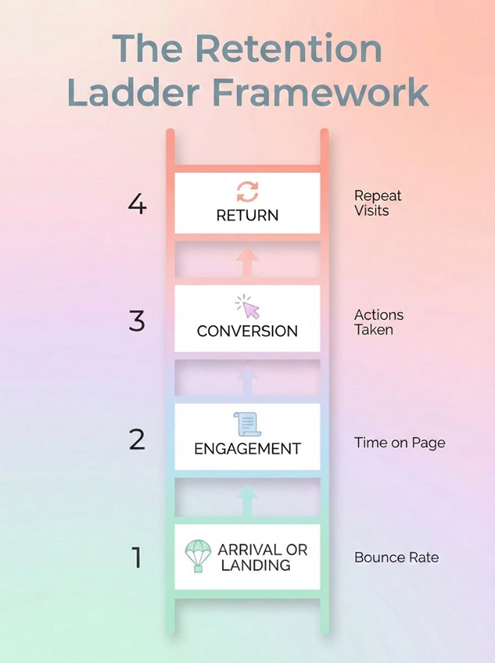
Rung 1 – Landing or arrival
This is the first and the simplest signal. Does the user stick around after landing or do they immediately bounce back to the previous path?
This is mostly determined by the above-the-fold design. It depends on how quickly the page is communicating that it is the right page for the given query. Some of the common mistakes at this rung include:
Slow loading time. It erodes intent before the page even renders.
Misleading title tags. Tags that set expectations the content doesn’t even meet.
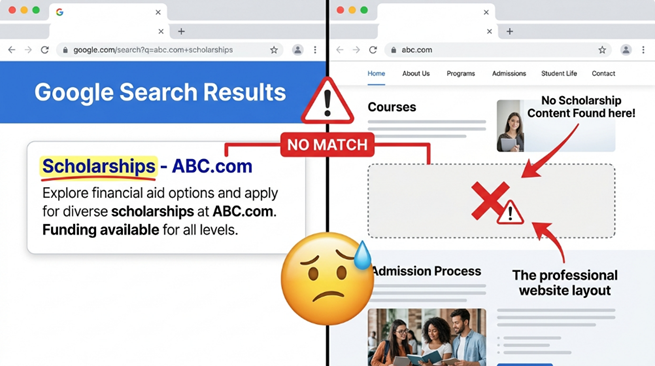
Cluttered above the fold layouts that make it difficult for the user to find what they came looking for.
Core Web Vitals matter here but they’re the floor, not the ceiling.
Editor’s Note: You might also like UX for SEO: Optimizing Core Web Vitals & Mobile-First Indexing
Rung 2 – Page engagement
Do users scroll and read?
The scroll depth is the proxy here for content relevance. Keep a close watch on how deep the users are diving into your page. If they read halfway through and leave, it means your content was relevant but didn’t maintain the momentum. However, if they consistently drop off that too within the first 20% of the page then the experience is likely broken.
Reason could be the broken information architecture or content chunking.
Example:
Here’s a case study showing how we solve this problem for the brand I am working with.
One of our conversion pages had many users landing but the scroll depth was only 15%, dwell time was also too low. Users were dropping off immediately. We analysed engagement metrics via GA, watched Clarity recording on where and how the users are dropping off and noticed a massive gap.
The content on the page was good; headings were decent but the narrative flow was broken. User couldn’t find the most important information till after 50% of the page.
What we did:
We sat down with the product team, sales team, conducted interviews with the students (our real users) and understood what matters to them the most. Based on the feedback and analysis we came up with a completely restructured page. We pulled the core-decision factors right on top and launched it as an AB test.
Bingo!
It worked. The restructured page saw an average time on page increase of 40% within 15 days of change.
SEO rankings quickly followed because we were ranking on some long tail, high conversion keywords.
Sharing here the screenshot of the before and after pages.
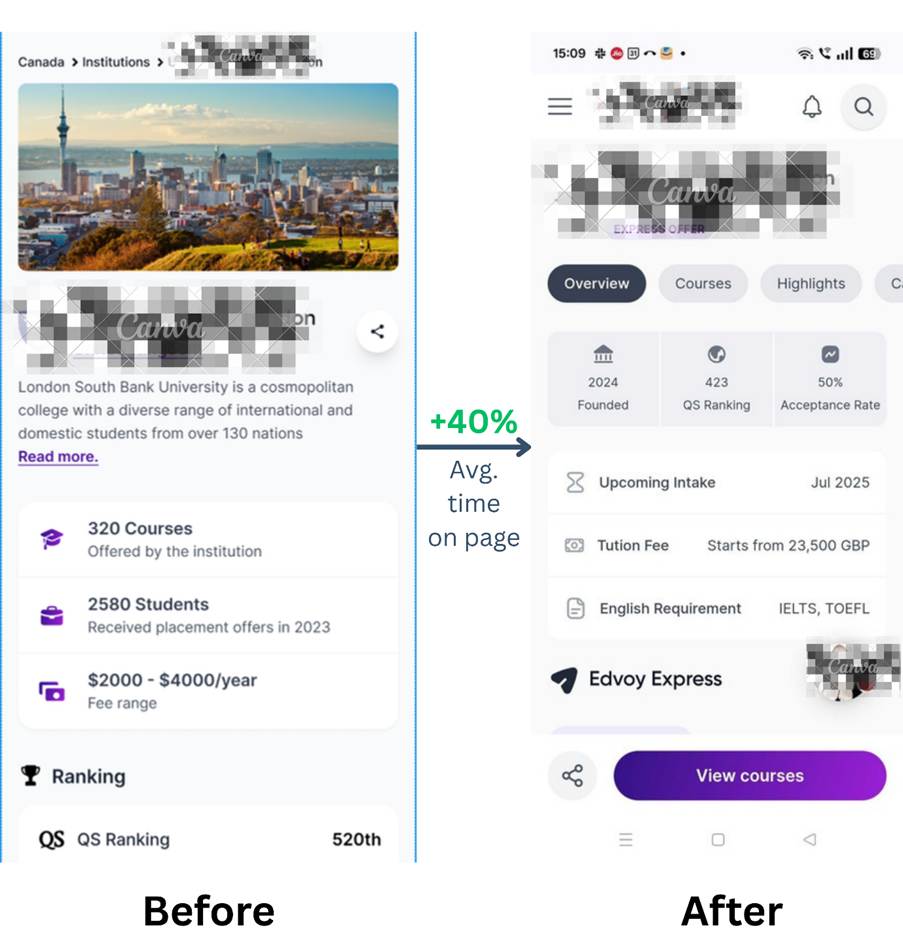
Good content, important highlights, quick links and a strategic use of tables & lists is a real retention mechanism and not just an editorial preference anymore.
Rung 3 – Conversions
Do users take the next step? A signup, form fill, download or a click to another page are all representative of users who saw enough value and acted upon it.
This is where UX and SEO strategy often diverge practically. The teams split into silos – SEO and CRO. On one hand, SEO team is busy focusing on the rankings and on the other hand the CRO or the product teams are busy converting the traffic. In reality, they must go hand in hand. High ranking means nothing if the users are bouncing back and a perfectly optimised funnel is useless without the users.
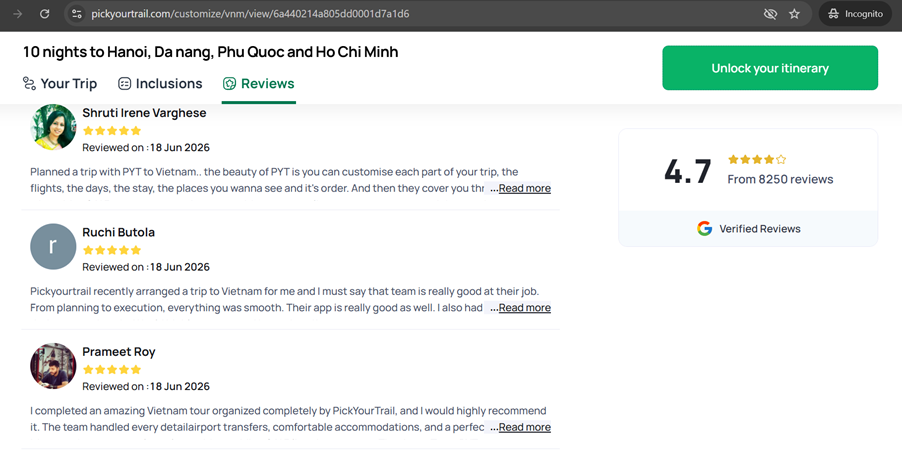
A page with high traffic but low conversions sends a weak signal to search engines. If even the conversion is just a click to another page, it indicates that users are finding what they are looking for. The right nudges, soft CTAs, internal linking and the right product messaging matters here as much as the primary content. This is where trust building also starts.
I have seen websites using customer testimonials like the ones below in their conversion flows.
Rung 4 – Repeat users
Do users come back?
Returning users are arguably the strongest retention signals. When they return, they are indicating that they trust your brand. For informational content, the recurring user visit is a sign that the page is now part of their research journey and not just some random search result.
This rung is one of the most difficult steps to generate directly. It is closely linked to brand recall or recognition. Pages that outline authors, showcase their credentials and provide thorough answers are the ones that garner most return visitors. Google’s E-E-A-T framework is a way of illustrating the rationale behind return visits.
The Crawlability trap
After following this framework, the most counterintuitive lesson I’ve learned is that over-optimising for crawlability can negatively impact the retention and thereby rank.
One common example is keyword stuffed headings. In my opinion, they’re written for crawlers not for users. The heading might tell search engines what the page is about but it doesn’t tell anything useful to the user. If a page follows the right narrative flow, the user will navigate the page quickly. If they can’t then they won’t stay.
Similarly, creating a website structure with an assumption of making more pages crawlable (an infinite category structure, thin tag pages, redundant topic splits) will only confuse users and reduce retention. Such pages can also lead to a huge cannibalisation issue.
Technical UX and SEO complement each other. The Retention Ladder reframes the question of “will a crawler understand this?” to “will the user stay because of this?” The second one is increasingly doing more of the ranking work.
How to audit pages through the retention lens
Here are a few starting points to apply this framework practically.
1.In GSC, look for the pages with a lot of impressions and clicks. Now check the engagement time (engagement rate and avg. session duration or avg. time on page) on these pages through GA4. A lower engagement clearly calls for a retention focused optimisation.
2.Scroll depth tracking (can be found as a default event in GA4) – this tells you where your users are dropping off. If more than 50% users drop off halfway, consider restructuring the page (narrative flow essentially).
3.Use heat mapping tools such as Hotjar, Microsoft Clarity (free). Heatmaps show you where attention and focus are concentrating and where they are lost.
4.Compare pages that are technically similar (similar domain authority, backlink profile and even similar keyword targeting). Check their engagement data. Is your technically stronger page underperforming over a weaker page? If the answer is yes, this is where retention is lower.
Do not overlook your site architecture
I have seen SEO teams discussing site architecture only for crawl efficiency. We often forget that it is also a retention system. A good user experience is also moving from one page to another seamlessly. Dumping users to a dead end with no related content, next steps or relevant navigation only loses behavioural signal at a point where it had to be the strongest.
Step into the shoes of your users, try to understand what else you would like to see while reading a page. Structure that anticipates where a users’ curiosity will go next gives the best experience to the users. This is where content clusters also help. Use tools like “Semrush topic researcher” to understand what else could be linked relevant to the topic.
The shift is already happening
Google’s Helpful Content Update has made it clear that the content that exists to rank rather than serving users intent is increasingly penalised. Pages where people want to spend the time on, are the ones that will win the race.
The Retention Ladder framework isn’t a replacement for technical SEO or link building; it is part of the rank equation that no SEO audit will explicitly measure. Analyse and see if your pages are delivering the experience that users want to see. Because increasingly, that’s where the rankings live.

Sitebulb is a proud partner of Women in Tech SEO! This author is part of the WTS community. Discover all our Women in Tech SEO articles.

Divya Jain is an SEO and content strategist currently working at Edvoy, an international education platform. She writes about behavioural SEO, international search markets, and AI citation strategies.

Related Articles
 Technical SEO Audit Reports: How to Turn Them into Client Retention Tools

 Enterprise SEO Audit: From Crawl to Prioritised Action Plan

 Which Rendering Approach is Best for SEO on E-commerce Sites?

 Sitebulb Desktop
Find, fix and communicate technical issues with easy visuals, in-depth insights, & prioritized recommendations across 300+ SEO issues.
- Ideal for SEO professionals, consultants & marketing agencies.
 Sitebulb Cloud
Get all the capability of Sitebulb Desktop, accessible via your web browser. Crawl at scale without project, crawl credit, or machine limits.
- Perfect for collaboration, remote teams & extreme scale.